
Moldavite Crystal Origin: The True Geological Story Behind a One-of-a-Kind Stone

The moldavite crystal origin is one of the most extraordinary stories in natural history. Unlike gemstones that form slowly inside the Earth, Moldavite was created in a single, violent moment that involved both the planet and outer space. This rare green stone exists because of a precise set of conditions that will never occur again. Understanding its origin is essential for anyone interested in authenticity, rarity, and long-term value.
This article explains where Moldavite comes from, how it formed, why it exists only in one region of the world, and why its origin defines everything about its identity.

The Cosmic Event That Created Moldavite
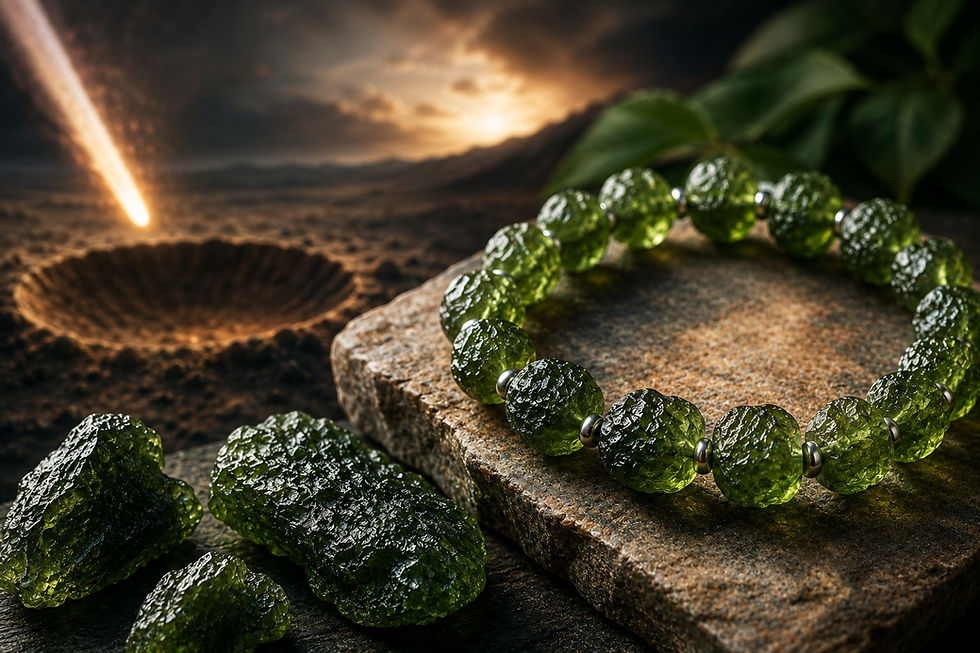
Around 15 million years ago, during the Miocene epoch, a massive meteor struck the Earth near what is now known as the Ries Crater in southern Germany. The impact released extreme heat and pressure, instantly melting the surface layers of Earth’s crust, including rock, soil, and silica-rich material.
Instead of remaining near the crater, some of this molten material was ejected high into the atmosphere at tremendous speed. As it traveled through the air, it cooled rapidly and solidified before falling back to the ground. This rapid cooling process prevented crystal structures from forming, resulting in natural glass. That glass is what we now call Moldavite.
This single event defines the entire moldavite crystal origin.
Why Moldavite Is Classified as a Tektite
Moldavite belongs to a rare group of natural materials known as tektites. Tektites are formed when terrestrial material is transformed by the extreme energy of a meteor impact. Moldavite is unique even among tektites because of its color, texture, and limited geographic distribution.
Because Moldavite cooled too quickly, it does not have a crystal lattice. This explains its irregular shapes, internal flow patterns, and glass-like structure. These physical traits are direct evidence of its impact origin and cannot be replicated naturally by any other process.
Where Moldavite Landed After Formation
Although the meteor impact occurred in Germany, genuine Moldavite is found almost entirely in the Czech Republic. The direction, force, and altitude of the ejected molten material caused it to fall primarily over regions that are now part of southern Bohemia and Moravia.
These areas provided the right environmental conditions for Moldavite to survive and be preserved for millions of years. No natural Moldavite has ever been found outside these Czech regions, making geographic origin the strongest indicator of authenticity.
How the Moldavite Crystal Origin Shaped Its Surface
After landing, Moldavite remained buried in Czech soil for millions of years. During this time, natural weathering processes slowly altered its surface. Groundwater, soil chemistry, and erosion etched grooves, pits, and sharp contours into the stone.
This long interaction with the environment is why authentic Moldavite has such distinctive surface textures. These features are not decorative; they are geological records of time and place. Artificial glass cannot naturally develop these patterns.
Human Interaction With Moldavite Through History
Long before modern science understood Moldavite, early humans encountered it. Archaeological discoveries show Moldavite was used tens of thousands of years ago in Central Europe. Some pieces were shaped into tools, while others appear to have been kept for symbolic or ceremonial reasons.
Throughout medieval history, Moldavite continued to appear in regional folklore and collections, often regarded as unusual due to its appearance and rarity. Over time, it became associated with the Czech lands, eventually gaining its modern name from the Moldau (Vltava) River.
Scientific Confirmation of Moldavite’s Origin
For centuries, scholars debated Moldavite’s origin. Some believed it was volcanic glass, while others suspected extraterrestrial influence. It was not until the 19th and 20th centuries that chemical analysis confirmed Moldavite’s true nature.
Scientists found that Moldavite’s composition matched terrestrial material altered by extreme heat, consistent with a meteor impact. The link to the Ries Crater was eventually confirmed, solidifying Moldavite’s place as one of the best-documented impact glasses on Earth.
Why the Moldavite Crystal Origin Makes It Permanently Rare
The moldavite crystal origin explains why Moldavite is permanently limited in supply. The meteor impact that created it happened once and cannot be repeated. There is no geological process that can create new Moldavite today.
As known deposits become depleted or protected, authentic Moldavite becomes increasingly scarce. This fixed supply is one of the reasons collectors and researchers place such importance on verified origin.
From Curiosity to Trust: A Natural Content Funnel
Most people first encounter Moldavite through curiosity about its color or reputation. Learning about its crystal origin transforms that curiosity into understanding. As readers begin to recognize the science and geography behind Moldavite, they develop confidence.
That confidence leads to trust—trust in facts, trust in sourcing, and trust in informed decision-making. Education becomes the foundation for authenticity, not persuasion.
Is Moldavite really formed by a meteor impact?
Yes, Moldavite was formed as a direct result of a meteor impact that occurred approximately 15 million years ago near the Ries Crater in southern Germany. The extreme heat generated by the impact melted surface rock and soil, which was then ejected into the atmosphere. As this molten material cooled rapidly while airborne, it solidified into natural glass before landing in the Czech Republic. This process has been confirmed through chemical analysis, isotopic dating, and geological correlation with the Ries impact site.
Why is Moldavite found only in the Czech Republic?
Moldavite is found only in the Czech Republic because the molten material created by the meteor impact traveled in a specific direction before cooling and falling back to Earth. The ejecta pattern caused it to land primarily over southern Bohemia and Moravia. Other regions did not receive this material or lacked conditions for preservation. Decades of geological research confirm that no natural Moldavite exists outside these Czech regions.
Is Moldavite a crystal or a type of glass?
Moldavite is technically a natural glass rather than a true crystal. It lacks a crystal lattice structure because it cooled too quickly for crystals to form. However, it is often referred to as a “crystal” in cultural and commercial contexts. Scientifically, it is classified as a tektite—impact glass formed from terrestrial material transformed by extreme heat and pressure during a meteor collision.
How does Moldavite’s origin affect its value?
Moldavite’s origin directly affects its value because it formed during a single, unrepeatable event. No new Moldavite can ever form naturally. As existing deposits decline and demand grows, authentic Moldavite becomes rarer. Stones with verified Czech origin and natural surface features hold greater long-term significance and are less likely to be confused with artificial imitations.
Why is understanding moldavite crystal origin important for buyers?
Understanding the moldavite crystal origin helps buyers distinguish genuine Moldavite from fake glass. Many imitations copy appearance but cannot replicate geological history. Knowing how and where Moldavite formed allows buyers to evaluate origin claims, surface textures, and internal features logically. This knowledge protects buyers from misinformation and supports confident, informed decisions.
Final Thoughts
The moldavite crystal origin is a story shaped by cosmic force, geological precision, and time. Moldavite exists because of one extraordinary moment in Earth’s past, and that moment defines everything about it today. Understanding this origin transforms Moldavite from a green stone into a documented piece of planetary history.


Comments