
History of Moldavite Crystal: From Ancient Legends to Czech Impact Fields

Updated: Dec 3, 2025
The history of Moldavite crystal is unlike any other stone on Earth. While most gemstones form slowly beneath the ground, Moldavite was created in a single explosive event that combined both the earth and the cosmos. Its origin story connects geology, astronomy, archaeology, and centuries of Central European tradition. For serious collectors, understanding this history adds depth and meaning to every piece.
The guide will discuss what we know about Moldavite from its cosmic birth, millions of years ago, to its meaning among various cultures and places.

A Cosmic Beginning: The Impact That Created Moldavite
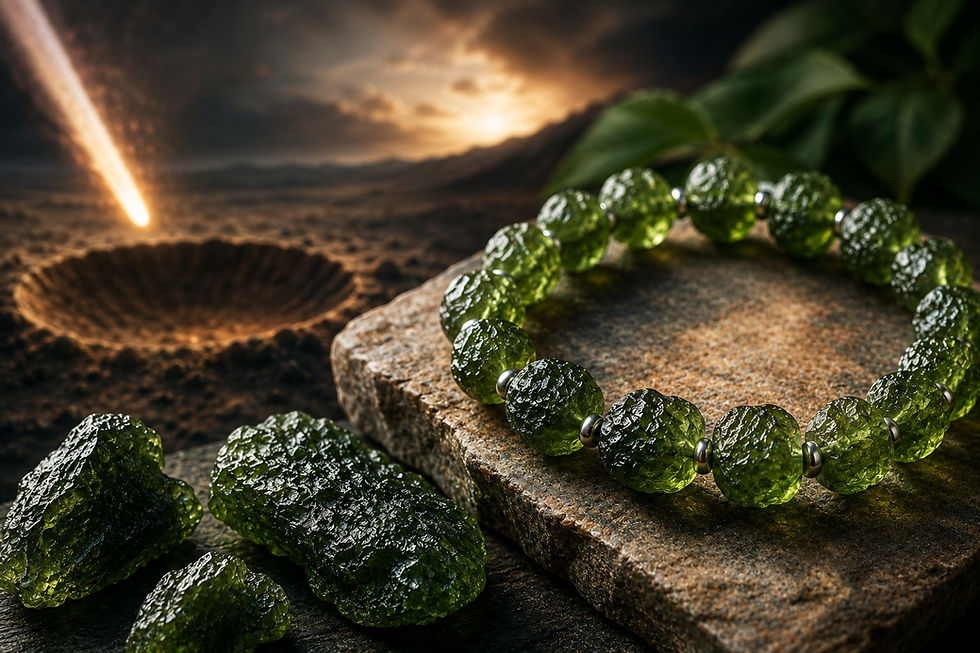
About 15 million years ago, a large meteorite hit southern Germany. The collision produced the Ries Crater, a huge impact site that actually melted earth, rock, and silica on contact.
The heat generated by the impact, in excess of 20,000°C, melted the surrounding material into liquid glass. This was thrown into the air and rained down in fragments over what is today the Czech Republic, predominantly in:
Southern Bohemia
Moravia
The historic Moldau River basin
As this molten material cooled in mid-air, it formed natural green tektite glass, which would come to be called Moldavite.
What makes Moldavite special:
It is not a classic mineral, but a tektite: these are formed from the rare collision of Earth with another heavenly body.
Early Human Encounters With Moldavite
Archaeologists have found Moldavite pieces in ancient tool-making sites that date back over 25,000 years. Early humans, especially in Central Europe, used Moldavite for cutting tools, amulets, and ceremonial objects.
Finds from the Paleolithic Venus sites in Czech regions strongly suggest that Moldavite was valued not just for its sharpness but also for its unusual green glow and mysterious origin. To early cultures, this was not merely a stone; it was a sky-born material with spiritual power.
Medieval Europe and the Moldau Tradition
The name “Moldavite” comes from the Moldau River (Vltava), near where some of the earliest recognized pieces were discovered. In medieval times, people often gave Moldavite as a protective charm. They believed it could guard against misfortune and help connect with higher knowledge.
In the Bohemian regions, Moldavite was associated with:
intuition
spiritual clarity
transformation
courage during personal change
These beliefs remain alive today, especially among collectors and crystal practitioners who value authenticity and natural origin.
The Renaissance and Scientific Attention
By the time European naturalists began studying stones and minerals during the Renaissance, Moldavite began attracting scientific interest. However, it wasn’t until the 18th and 19th centuries that researchers realized Moldavite’s true nature.
In 1786, Moldavite was officially recognized as a unique natural glass. By the mid-1800s, early geologists connected Moldavite to a meteorite impact, although this theory took decades to gain acceptance.
The Ries Crater connection wasn’t confirmed until the 20th century, when evidence finally proved that Moldavite was formed by a single cosmic event.
Modern Discovery and Scientific Recognition
In the 20th century, Moldavite became widely studied, admired, and collected. Scientists categorized Moldavite into various texture grades, including:
Regular smooth varieties
Distinctive “chiseled” formations
Spiky and sharp Besednice textures
Museum-grade pieces with exceptional surface detail
Collectors now understand Moldavite not only as a rare tektite but as a geological snapshot of one of Earth’s most powerful natural events.
Rarity and Decreasing Supply
The history of Moldavite is also a story of limited availability. Since it formed in a single event that will never happen again, the supply cannot be renewed. Many original Czech fields are now depleted or closed.
This is why authentic Moldavite from Czech regions continues to grow in value and significance, especially among serious collectors.
All Moldavite connected to Czech impact fields carries the legacy of its formation—and every year, fewer genuine pieces remain accessible.
Cultural and Spiritual Legacy Across Time
Throughout history, Moldavite has symbolized transformation. Ancient people viewed it as a sky-born gift. Medieval Bohemians connected it with intuition and personal evolution. Modern collectors appreciate both its historical meaning and its geological rarity.
Today, Moldavite’s legacy includes:
a direct link to the Ries impact
thousands of years of human use
a cultural role in Czech and Bohemian regions
a reputation for transformative energy
Its history continues to influence how collectors view and value each piece.
Why Moldavite’s History Matters to Collectors
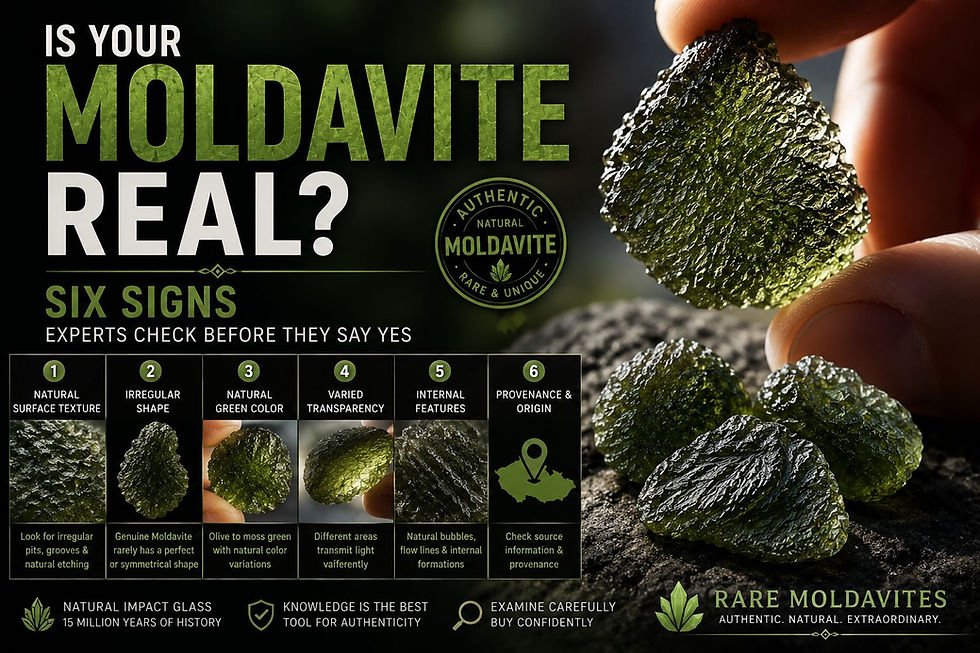
Understanding the history of Moldavite crystal helps collectors distinguish real Czech pieces from widespread imitations. Authentic Moldavite carries the unmistakable signature of its origin:
natural etched texture
layered formation
unique green color
impact-born sculpting
limited source locations
True Moldavite has a story that cannot be copied or manufactured.
Collectors who choose certified pieces from Czech fields are preserving a small piece of natural and cosmic history.
FAQ: History of Moldavite Crystal
Is Moldavite really from a meteor impact?
Yes, Moldavite was formed 15 million years ago when a meteor struck the Earth near what is now southern Germany. The impact melted the surrounding ground and created green tektite glass that landed in Czech regions.
Where was Moldavite discovered historically?
The earliest recognized finds came from areas near the Moldau River in the Czech Republic. Archaeologists later found evidence of Moldavite use in ancient human sites across Central Europe.
Why is Moldavite considered rare today?
All Moldavite formed in one event. Many Czech mining areas are depleted or protected, and global demand has increased, making authentic Moldavite harder to obtain.
Has Moldavite been used for spiritual purposes in history?
Yes. Ancient and medieval cultures believed Moldavite supported intuition, clarity, and transformation. These beliefs continue in modern spiritual practices.
Why is Moldavite’s history important for collectors?
Its history proves authenticity. Real Moldavite has a specific origin, texture, and geological signature linked directly to Czech impact fields.
Conclusion: A Crystal Shaped by Cosmic Forces and Human History
From a meteorite impact millions of years ago to ancient human admiration and modern scientific study, Moldavite has carried an extraordinary legacy. Its rarity, geological significance, and cultural symbolism continue to attract collectors, historians, mineralogists, and spiritual enthusiasts around the world.
Moldavite remains one of the most fascinating natural materials ever discovered—a true combination of Earth and cosmic history.
If you want to get more Information Visit: (Is Moldavite Rare? A Collector’s Guide to Scarcity, Origin, and Value )

Comments