
Is Moldavite Rare? A Collector’s Guide to Scarcity, Origin, and Value

Moldavite is not only visually striking; it is also rare in a way few gemstones are. The question “is Moldavite rare?” has practical, geological, and market implications. This guide explains why Moldavite’s scarcity is unique, what determines rarity, and how collectors can evaluate authenticity and long-term value.
What “rare” means for Moldavite
Unlike most gems that form gradually deep underground, Moldavite formed in a single, high-energy event: a meteorite impact about 15 million years ago. That event created a limited volume of natural glass—tektite—that landed mainly in a few narrow regions of the Czech Republic. Because Moldavite’s origin is tied to one moment in Earth’s history, its supply is inherently finite. That makes “rare” not just a marketing word but a geological fact. Key points:
Moldavite’s formation was a single, non-repeatable event.
Natural deposits occur only in specific Czech regions.
There is no way to create more natural Moldavite in the ground.

Geological sources and why location matters
Authentic Moldavite originates from tight clusters in South Bohemia and parts of Moravia, frequently referenced by collectors as the Moldau (Vltava) basin, Chlum, and Besednice areas. Each locality produces stones with subtly different textures and hues. Because these fields are small and many are now closed or exhausted, high-quality material is harder to find than it was just decades ago.
Why locality matters:
Different fields yield characteristic textures (e.g., Besednice spiky forms).
Provenance affects collector preference and price.
Local restrictions and depleted deposits reduce available supply.
Factors that increase rarity and value
Not all Moldavite is equally rare. Several factors determine scarcity and market value:
Size — Large, intact specimens are far rarer than small fragments.
Quality and clarity — Stones with clear internal structure and minimal weathering command higher premiums.
Unusual textures — Distinctive, well-preserved surface sculpting (e.g., hedgehog-like spikes) is prized.
Provenance — Verified locality from a high-value field increases desirability.
Historic or museum grade — Pieces with documented excavation history or exceptional aesthetics are rare collectibles.
Collectors often seek specimens that combine several of these attributes: large size, crisp texture, deep color, and verified field origin.
Why the market shows more fakes — and what that means
The natural scarcity of Moldavite has led to widespread counterfeits: green glass, resin casts, and heat-treated materials sold as genuine. That proliferation can make Moldavite seem less rare to casual buyers, but it actually underscores the stone’s scarcity—counterfeiters fill demand when real supply is limited. For collectors, this situation increases the importance of authentication and trusted sourcing.
Practical implication:
The presence of many fakes makes verified provenance and lab testing more valuable than ever.
How collectors confirm rarity and authenticity
To judge rarity and ensure authenticity, collectors rely on a mix of visible features, documentation, and professional verification.
Visual and tactile checks:
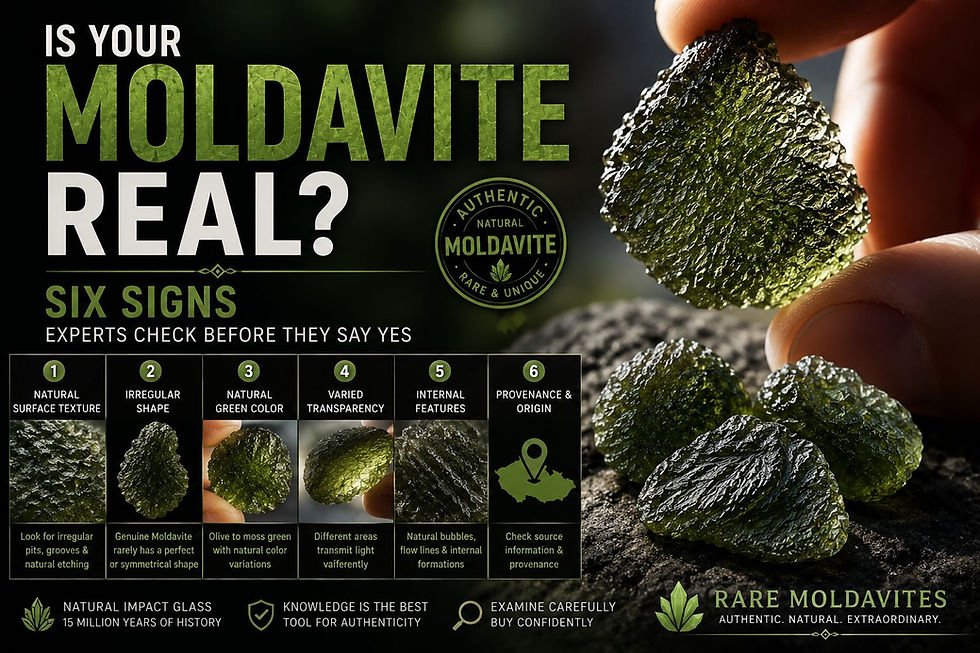
Natural etching and flow lines on the surface (not machine-made patterns).
Deep olive to forest green color with subtle internal variation (not neon or uniformly bright).
Irregular, aerodynamic shapes consistent with impact formation.
Small, irregular bubbles and inclusions (not perfect round air bubbles typical of factory glass).
Documentation and testing:
Field provenance (seller provides mine or region).
High-resolution photos of the exact specimen.
Certificate of authenticity from a trusted source or third-party lab testing when available.
Microscopic or spectral analysis for high-value pieces.
At Rare Moldavites, every piece is examined for these markers and supplied with provenance information to support collector confidence.
Investment outlook: is Moldavite a good long-term hold?
Because Moldavite supply is finite and demand from collectors and spiritual markets persists, certain high-quality specimens have shown increasing collector interest. Prediction factors include continued depletion of accessible fields, growing collector awareness, and the cultural value attached to documented provenance.
That said:
Not all Moldavite will appreciate equally—quality, documentation, and rarity drivers are crucial.
Short-term price volatility exists; treat Moldavite as a specialist collectible rather than a guaranteed appreciating asset.
Low-priced pieces without provenance are not reliable investment vehicles.
Care, preservation, and ethical considerations
Preserving a rare Moldavite increases its long-term value. Avoid harsh chemicals, sudden temperature changes, and abrasive cleaning. Store specimens in padded boxes and document acquisition details (date, supplier, provenance).
Ethical sourcing matters. Favor sellers who work with documented Czech suppliers and who practice responsible collecting that respects land use and local regulation.
FAQ — Is Moldavite Rare?
1. How rare is Moldavite in simple terms?
Moldavite is rare because it formed in a single meteor impact and exists only in limited Czech fields. Once accessible material is exhausted, no new natural supply will form.
2. Are large Moldavite pieces especially rare?
Yes. Larger, intact specimens are far rarer than smaller fragments, and they command higher prices among collectors.
3. Does rarity mean all Moldavite is expensive?
Not necessarily. Rarity varies by size, texture, provenance, and quality. Small or heavily weathered pieces can be affordable; large, museum-grade examples are costly.
4. How does provenance affect rarity?
Provenance confirms the Czech origin and field, which boosts value. Moldavite with a documented field history is rarer in the collector market.
5. Can Moldavite supply increase in the future?
No. Moldavite formed during one geological event; natural supply cannot be renewed. Remaining supply depends on what has not yet been collected or is still legally accessible.
6. How to avoid buying fake Moldavite?
Buy from reputable dealers who provide provenance, high-resolution photos of the exact piece, and certificates. Use visual checks (texture, color, internal structure) and seek third-party verification for high-value stones.
7. Is Moldavite a good long-term collectible?
Quality, verified provenance, and rarity are the primary drivers of long-term value. Premium specimens from known localities are more likely to retain or grow in value.
Closing — What collectors should do next
Collectors who value authenticity should prioritize provenance and expert verification above price. Document every purchase and store Moldavite carefully. If you want to explore certified pieces or seek valuation guidance, Rare Moldavites offers verified specimens and transparent provenance details for collectors who want stones with a genuine geological story.
If you want to get more Information Visit: ( History of Moldavite Crystal: From Ancient Legends to Czech Impact Fields)

Comments