
How to Identify Real Moldavite: Collector-Trusted Guide to Authentic Czech Stones

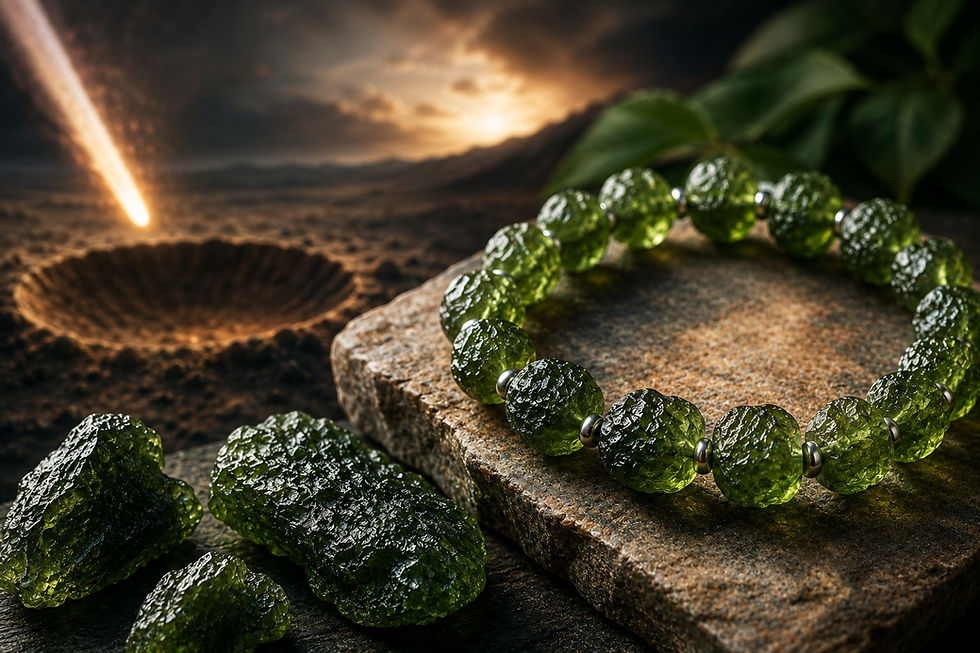
Real Moldavite is one of the most sought-after tektites on Earth. It formed only once, around 15 million years ago, when a meteor impacted the region near the Ries Crater. That impact launched molten material into what is now the Czech Republic. As it cooled mid-air, it transformed into the rare, deep-green glass we now know as Moldavite.
Because natural deposits are nearly exhausted and collector demand continues to rise, fake Moldavite has become more common than ever. This makes it important for buyers, collectors, and enthusiasts to learn how to identify real Moldavite with confidence.
This guide breaks down the most reliable identification methods based on origin, geological structure, natural textures, and trusted sourcing — explained simply, without confusion.

Why Authentic Origin Matters Most
Real Moldavite exists only in three primary Czech regions:
• Southern Bohemia
• Moravia
• The Moldau (Vltava) River Basin
Any Moldavite sold from other countries is either misrepresented tektite or artificial glass. Authentic origin is the foundation of identification, because Moldavite’s true characteristics come directly from its meteor-impact formation process and millions of years of natural weathering in Czech soil.
A trustworthy supplier should openly share the exact locality and provide documentation proving Czech origin.
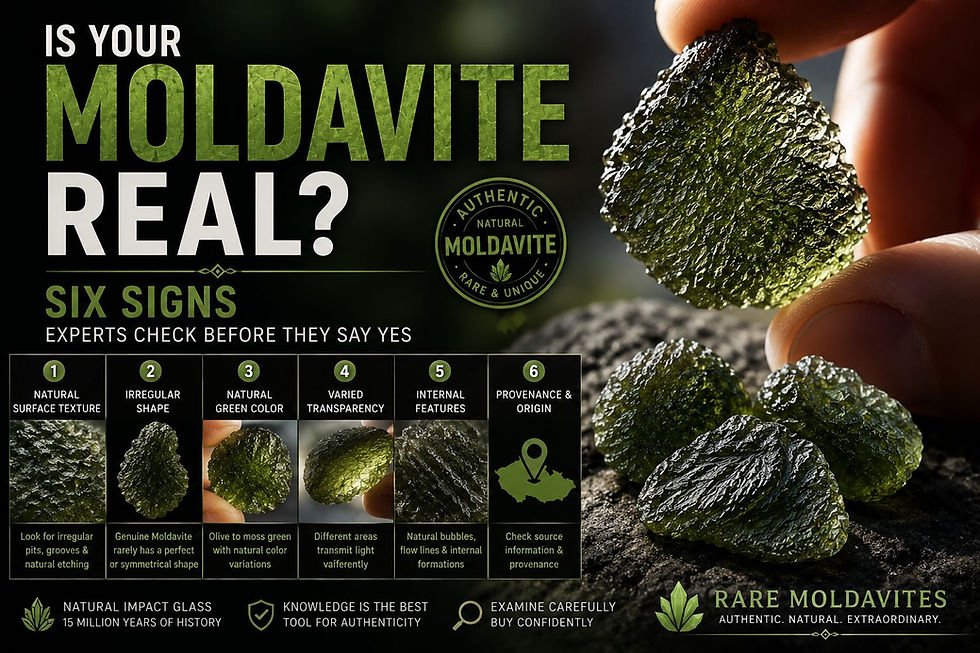
Natural Moldavite Color: Deep Greens With Variation
A major clue for spotting genuine Moldavite is color range. Though each locality differs slightly, real Moldavite is never neon or overly bright.
Authentic Moldavite colors include:
• Deep forest-green
• Olive-green
• Moss-green with subtle brown tones
• Rare smoky-green hues
The color should shift slightly under different lighting and look natural, never perfectly uniform.
Fake pieces often appear:
• Too bright
• Transparent like bottle-glass
• Evenly colored with no depth
This is one of the simplest early checks.
Surface Texture: Moldavite’s Most Telling Feature
Real Moldavite’s texture is a result of:
• Rapid cooling in the air during the impact
• Millions of years of chemical weathering
• Natural erosion from Czech soil
This creates the famous etched and sculpted appearance serious collectors love.
Key signs of real Moldavite texture:
✔ Rough, complex surface
✔ Irregular grooves and wrinkles
✔ Naturally sculpted (not carved)
✔ No symmetry or smooth factory finish
Fake Moldavite is usually:
✘ Too smooth
✘ Glossy like melted glass
✘ With repeating, artificial patterns
If it looks perfect — it’s probably fake.
Internal Structure: Impact-Born Inclusions
Under strong light, real Moldavite reveals tiny internal details:
• Bubbles that are stretched or oval-shaped
• Flow lines from molten movement in flight
• No large round bubbles like factory glass
The inside should look formed by an intense natural event, not like a decorative paperweight.
Weight and Density: Lighter Than You Think
Real Moldavite is surprisingly light due to its natural tektite structure. When two pieces are similar in size, genuine Moldavite should:
• Feel lighter
• Not feel dense like thick melted glass
While subtle, trained collectors can identify fake weight quickly.
Shape Matters Too
Each Moldavite broke apart uniquely while airborne. This leads to shapes that are:
• Jagged
• Curved organically • Aerodynamic in some cases (tear-shaped)
Perfect circles, cubes, and overly smooth forms are red flags.
Where and How You Buy Makes a Difference
The fastest way to protect yourself from fakes is choosing the right seller.
A trustworthy supplier will provide:
• Field origin confirmation
• Clear, realistic product photos
• Certification
• Details about locality and texture grade
Rare Moldavites follows these practices so collectors know they are purchasing stones with verified history and geological significance.
Why Real Moldavite Is Rare and Valuable
• It formed only once in Earth’s history
• Mining regions have shut down or emptied
• More collectors enter the market every year
This combination means prices rise as supply permanently shrinks.
If Moldavite seems suspiciously cheap — it is almost certainly fake.
FAQ: How to Identify Genuine Moldavite
What is the fastest way to spot a fake Moldavite?
The quickest warning sign is a smooth, shiny surface. Real Moldavite always shows rugged, naturally carved textures formed through millions of years in Czech soil. If it looks like melted bottle-glass, it’s not genuine. Rare Moldavites always provides verified pieces that show true impact-born surfaces.
Should real Moldavite come with documentation?
Yes. Trusted sources provide confirmation of Czech locality and authenticity. If a seller refuses to share origin details or certification, it’s a major red flag. Rare Moldavites includes documentation with each collector stone, so buyers know the exact region their Moldavite was found.
Is everything called “green tektite” actually Moldavite?
No. Moldavite is exclusive to Czech impact fields. Any other green tektite sold from outside the Czech Republic is incorrectly labeled. Rare Moldavites specializes only in genuine Czech Moldavite, ensuring buyers do not unknowingly purchase imposters.
Why are fake Moldavites so common now?
Demand for Moldavite has increased globally, while natural deposits are nearly gone. That scarcity makes fakes profitable for dishonest sellers. Rare Moldavites safeguards collectors by offering only certified stones sourced directly from trusted Czech partners.
Does size affect authenticity?
Size does not prove whether Moldavite is real or fake. However, larger genuine stones are extremely rare and hold higher value due to limited supply. At Rare Moldavites, pricing always reflects true rarity and field-verified origin, protecting buyers from overpriced glass.
Final Guidance for Collectors
Learning how to identify genuine Moldavite helps protect this once-in-history gemstone from imitation. Real Moldavite should always show:
✔ Natural texture
✔ Impact-formed inclusions
✔ Authentic Czech origin
✔ Real collector value
With educated buying decisions and trusted sourcing, collectors preserve not only a gemstone — but a cosmic fragment of Earth’s past.

Comments