
Moldavite Crystal Origin: The True Story Behind Earth’s Rarest Green Tektite
- Rare Moldavites

- Dec 15, 2025
- 5 min read
The moldavite crystal origin is one of the most extraordinary stories in the natural world. Unlike most gemstones that form deep inside the Earth over long periods of time, Moldavite was created in a single cosmic event that can never happen again. Its story connects astronomy, geology, ancient human history, and modern collecting into one continuous narrative.
Understanding Moldavite’s origin is essential for anyone who wants to recognize genuine pieces, appreciate their rarity, and separate real Czech Moldavite from widespread imitations.
A Cosmic Event That Changed Earth Forever
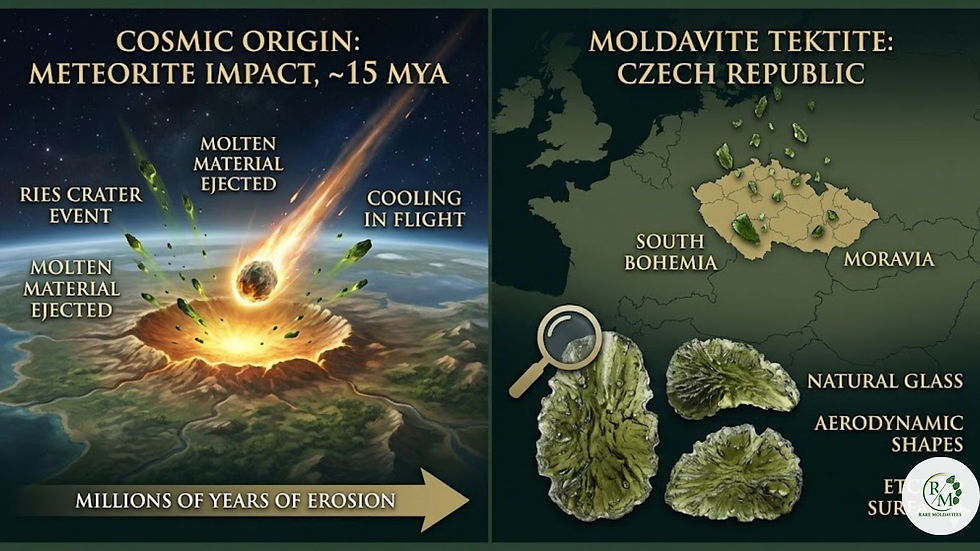
Approximately 15 million years ago, a massive meteorite struck what is now southern Germany. This impact created the Ries Crater, one of the most studied meteorite craters on Earth. The collision released unimaginable energy, instantly melting surface rock, soil, and minerals at extreme temperatures.
The molten material was blasted high into the atmosphere and scattered across a wide region. As this material cooled while airborne, it formed natural green tektite glass. These fragments eventually fell and settled primarily in what is now the Czech Republic.
This event marks the exact moldavite crystal origin. There was no slow formation, no repeated geological process, and no second occurrence. Moldavite exists because of one singular moment in Earth’s history.
Why Moldavite Is Not a Typical Mineral
Moldavite is classified as a tektite, not a mineral. Minerals form through stable chemical processes over time. Moldavite formed instantly through violent impact, pressure, and heat.
This explains why Moldavite has:
No crystal structure
Natural glass composition
Flow lines and bubbles
Aerodynamic shapes
Etched and sculpted surfaces
Its structure directly reflects the chaos of its creation, making every genuine piece physically unique.
Czech Impact Fields: The Only Source of Real Moldavite
All authentic Moldavite comes from limited regions within the Czech Republic. These areas lie along the path where molten material landed after the impact.
Historically significant regions include:
South Bohemia
Moravia
Areas surrounding the Moldau (Vltava) River
Each locality produces Moldavite with slightly different textures, shapes, and surface characteristics. These variations help experts trace origin and confirm authenticity.
No Moldavite forms naturally anywhere else on Earth.
How Time Shaped Moldavite After Formation
After falling to the ground, Moldavite spent millions of years buried in Czech soil. During this time, natural chemical weathering sculpted its surface. Rainwater, minerals, and temperature changes slowly etched the stone, creating the rugged textures collectors recognize today.
This erosion is crucial. Genuine Moldavite always shows signs of natural aging. Smooth or glossy surfaces usually indicate artificial glass rather than authentic tektite.
Early Human Interaction With Moldavite
Archaeological evidence shows that humans discovered Moldavite tens of thousands of years ago. Pieces have been found in prehistoric tool-making sites across Central Europe.
Early humans valued Moldavite for:
Sharp edges useful for tools
Unusual green color
Perceived spiritual significance
Its sky-born nature likely made it sacred long before scientific explanations existed.
Cultural Significance in Central Europe
In medieval Bohemia, Moldavite became associated with protection, insight, and transformation. It was sometimes worn as a talisman or placed in ceremonial objects.
Its cultural value persisted through centuries, especially because people recognized that Moldavite was different from ordinary stones. The idea that it “fell from the sky” remained part of local tradition.
Scientific Recognition and Modern Understanding
By the 18th and 19th centuries, European scientists began studying Moldavite seriously. Eventually, chemical analysis confirmed its connection to the Ries impact.
Modern science now recognizes Moldavite as one of the most important tektites on Earth. It provides physical evidence of meteorite impacts and helps researchers understand planetary collisions.
Why Moldavite Is Becoming Increasingly Rare
The moldavite crystal origin explains why supply is permanently limited. Since it formed only once, no new Moldavite can ever be created.
Most known Czech deposits are now:
Exhausted
Protected
Closed to mining
As demand grows worldwide, genuine Moldavite becomes harder to obtain, while fake glass imitations increase.
Why Understanding Origin Protects Buyers
Knowing the true origin helps buyers:
Identify authentic texture and structure
Avoid misrepresented “green tektite” claims
Understand fair pricing
Recognize why certified pieces matter
Origin knowledge is the strongest defense against counterfeits.
The Legacy of Moldavite Today
Today, Moldavite stands at the intersection of science, history, and collecting. It is valued not because it is trendy, but because it is finite, verifiable, and geologically irreplaceable.
Every genuine piece carries physical evidence of a cosmic event that shaped part of Europe millions of years ago.
1. What exactly is the moldavite crystal origin?
The moldavite crystal origin traces back to a meteorite impact near the Ries Crater 15 million years ago. Molten Earth material was ejected and cooled into green tektite glass across Czech regions, forming Moldavite through a single, unrepeatable event.
2. Why does Moldavite only come from the Czech Republic?
The meteor impact scattered molten material only across specific Czech areas. Since no other region received this ejecta, authentic Moldavite exists exclusively within Czech impact fields, including locations associated with besednice moldavite formations.
3. How does erosion affect Moldavite’s appearance?
After formation, Moldavite spent millions of years underground, where natural erosion etched its surface. This process creates rugged textures and sculpted shapes, which are essential markers of authenticity, especially in high-quality besednice moldavite specimens.
4. Is Moldavite considered a gemstone or something else?
Moldavite is classified as a tektite, not a traditional gemstone. Its glass-like structure results from extreme heat and pressure, making it scientifically distinct from minerals formed through slow geological processes.
5. Why do different Moldavite regions look different?
Each Czech locality experienced different cooling conditions and erosion patterns. This is why pieces vary in texture, shape, and surface detail, with besednice moldavite known for sharp, deeply sculpted formations.
6. Can Moldavite ever form again naturally?
No. Moldavite formed from a single meteor impact. Since the conditions that created it will never repeat, the global supply is permanently limited, making genuine Czech Moldavite increasingly rare.
7. Why is Moldavite often confused with other green tektites?
Other green tektites exist, but they originate from different impacts and regions. Only Czech impact glass qualifies as Moldavite. Stones sold outside this origin are misidentified, unlike verified besednice moldavite.
8. How does origin influence Moldavite’s value?
Origin determines rarity, authenticity, and collectability. Pieces from recognized Czech localities, especially besednice moldavite, command higher value due to limited supply and distinctive surface characteristics.
9. What role does science play in verifying origin?
Chemical composition, internal structure, and surface morphology allow experts to confirm origin. These scientific markers match only Czech impact material and cannot be reproduced in artificial glass.
10. Why does origin matter more than size?
Size alone does not guarantee authenticity. A small piece with verified origin and natural erosion is far more valuable than a large, smooth imitation. True origin, including besednice moldavite classification, defines legitimacy.
Final Thought
The moldavite crystal origin is not a marketing story—it is a documented geological reality. Understanding it allows collectors and enthusiasts to recognize authenticity, respect rarity, and appreciate Moldavite for what it truly is: a physical record of Earth’s encounter with the cosmos.


Comments