
How Experts Identify Authentic Moldavite: Beyond Real vs Fake (2026 Guide)

QUICK ANSWER BOX
How to identify Moldavite involves examining several geological characteristics together rather than relying on one feature. Experts evaluate natural surface etching, internal flow structures, color, provenance, Czech locality, and overall preservation. Authentic Moldavite formed during a meteorite impact approximately 14.8 million years ago, giving every genuine specimen distinctive natural features that manufactured glass cannot perfectly reproduce.
INTRODUCTION
Finding authentic Moldavite has become more challenging than ever. As interest in this remarkable green tektite continues to grow worldwide, counterfeit specimens have become increasingly sophisticated. Many imitations now look convincing enough to confuse even experienced buyers when viewed only through online photographs.
Understanding how to identify Moldavite requires more than comparing color or checking for rough texture. Genuine Moldavite carries evidence of an extraordinary geological history that began nearly 14.8 million years ago during the Ries meteorite impact. Every authentic specimen preserves clues created by that event, from microscopic flow structures to naturally sculpted surfaces formed over millions of years beneath Czech soil.
This guide goes beyond the typical "real versus fake" checklist. Instead, it explains the scientific reasons behind each identifying feature while also exploring how museums, geology enthusiasts, and experienced collectors evaluate authentic Czech Moldavite today. You will also discover why provenance has become increasingly important as many exceptional specimens now reside within established private collections.
Who This Is For: Crystal enthusiasts, geology lovers, mineral collectors, museum researchers, jewelry buyers, and anyone wanting to understand authentic Czech Moldavite.
TABLE OF CONTENTS
Why Moldavite Is One of the World's Most Counterfeited Tektites
The Geological Story Behind Authentic Moldavite
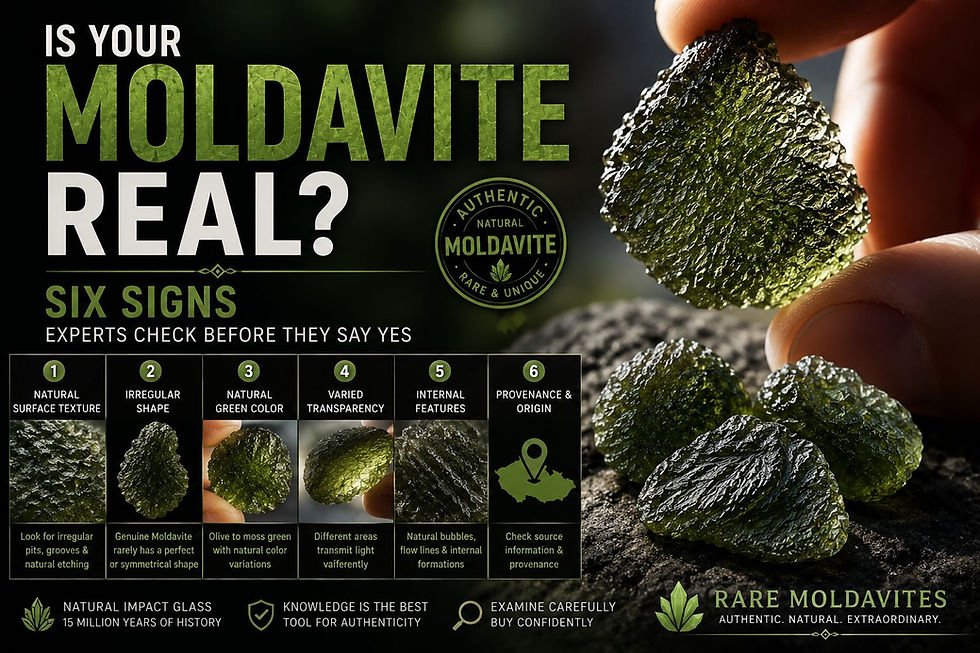
Six Geological Features Experts Examine
Why Rough Texture Alone Cannot Prove Authenticity
The Importance of Czech Provenance
How Modern Counterfeits Are Manufactured
Why Moldavite Is One of the World's Most Counterfeited Tektites
The phrase " Moldavite real has become one of the most searched questions among collectors because counterfeit Moldavite is now more common than ever before. Increased global demand has encouraged manufacturers to produce imitation specimens using green glass, molded materials, acid-etched surfaces, and artificial weathering techniques. While many copies appear convincing in photographs, they rarely withstand detailed geological examination.
The authentic Moldavite found today originated from a single meteorite impact approximately 14.8 million years ago. Unlike gemstones that continue forming naturally beneath Earth's surface, Moldavite cannot be replaced once existing deposits become exhausted. This finite supply naturally attracts collectors, museums, and researchers, while also creating opportunities for counterfeit products to enter the market.
Many beginners believe authenticity can be determined using only one feature, such as rough texture or deep green color. Unfortunately, modern counterfeit manufacturing has evolved significantly. Artificial acid etching can imitate weathered surfaces, while carefully controlled glass production can reproduce colors surprisingly well. This means identification now requires examining multiple geological characteristics together.
A common mistake I see is that buyers trust dramatic marketing claims more than observable geological evidence. Authentic Moldavite does not need exaggerated stories to demonstrate its value. Its remarkable origin, limited occurrence within the Czech Republic, and naturally preserved textures already provide one of the most fascinating geological histories found in any collector specimen. Understanding why Moldavite is unique begins with understanding exactly how nature created it. Once that formation process becomes clear, identifying genuine specimens becomes much easier.

The Geological Story Behind Authentic Moldavite
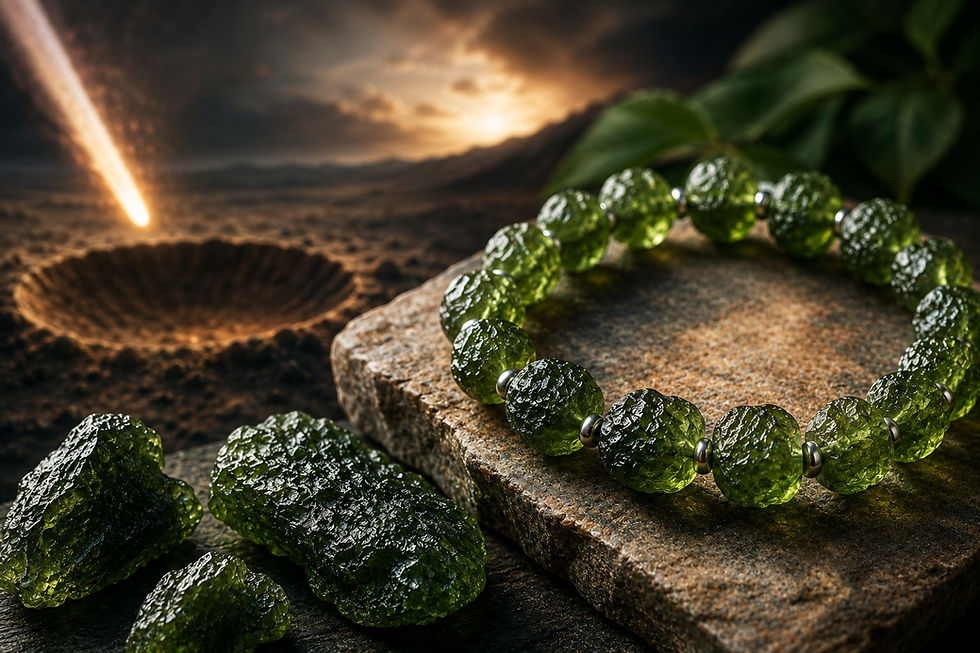
The authentic Moldavite is defined as a natural green tektite created during the Ries meteorite impact approximately 14.8 million years ago. This impact occurred near present-day southern Germany when a massive meteorite struck Earth with extraordinary force. The tremendous heat instantly melted surrounding rocks and sediments, launching molten material high into the atmosphere.
While suspended in the atmosphere, this molten material cooled rapidly before returning to Earth across areas that are now primarily located within the Czech Republic. During this cooling process, natural flow structures, elongated gas bubbles, and distinctive surface characteristics developed inside every specimen. These features remain some of the strongest geological indicators used during modern authentication.
Unlike volcanic glass or laboratory-produced glass, Moldavite carries physical evidence of both atmospheric flight and long-term burial. Millions of years beneath Czech soils gradually enhanced its naturally sculpted surface through weathering and chemical interaction with surrounding sediments. This combination of impact formation and geological aging produces textures that modern manufacturing struggles to duplicate consistently.
Understanding this geological process explains why authentic Moldavite rarely appears perfectly symmetrical or perfectly smooth. Nature creates irregularity. Every fold, ridge, depression, and natural contour reflects an unpredictable formation process that cannot be precisely repeated inside a factory.
For collectors, understanding this history changes how every specimen is viewed. Instead of simply seeing a green stone, they begin recognizing a rare geological record preserved from one of Earth's most dramatic impact events. This scientific perspective forms the foundation for every professional authentication method used today.
Six Geological Features Experts Examine Before Confirming Authenticity
Experienced collectors never rely on one characteristic alone when determining how to identify genuine Moldavite. Instead, they combine several geological observations to build confidence before reaching a conclusion. This systematic approach reduces the risk of mistaking modern imitations for authentic specimens.
Natural Surface Sculpture
The first characteristic experts examine is the surface. Authentic Moldavite displays naturally etched textures created through millions of years of weathering beneath Czech soils. These patterns appear irregular, deeply sculpted, and entirely random. Artificially etched glass often looks repetitive, shallow, or mechanically consistent under magnification.
Internal Flow Structures
One of the strongest indicators lies beneath the surface. Genuine Moldavite commonly contains elongated flow lines created while molten material cooled rapidly during atmospheric flight. These structures cannot easily be reproduced using ordinary glass manufacturing techniques and remain one of the most valuable authentication features.
Natural Gas Bubbles
Authentic Moldavite frequently contains elongated or irregular gas bubbles formed naturally during rapid cooling. In contrast, manufactured glass often contains perfectly round or uniformly distributed bubbles. Magnification usually reveals these important differences.
Natural Color Variation
The color of authentic Moldavite generally ranges from olive green to deep forest green. Variations occur naturally depending on locality, thickness, and preservation. Perfectly uniform bright green coloration deserves closer examination because nature rarely produces complete consistency across every specimen.
Overall Shape
Authentic Moldavite rarely follows predictable geometry. Every specimen developed through chaotic natural processes involving molten material, atmospheric flight, and geological weathering. Symmetrical shapes or polished edges often indicate later modification or manufactured imitation rather than natural formation.
Provenance
Finally, experts evaluate where the specimen originated. Authentic Moldavite comes almost exclusively from recognized Czech localities. Reliable provenance, historical documentation, and transparent sourcing often provide confidence that visual inspection alone cannot achieve.
These six geological characteristics work together as a complete evaluation system rather than separate tests. The next section explains why one of the most popular identification methods surface texture can sometimes mislead even experienced buyers.
Why Rough Texture Alone Cannot Prove Authenticity
Many collectors believe that a rough surface automatically means a specimen is genuine. While natural texture is an important feature, it should never be treated as the only test. Modern counterfeit Moldavite has become increasingly sophisticated, and some manufacturers now use acid etching or mechanical techniques to imitate the weathered appearance of authentic Czech Moldavite. At first glance, these artificial textures may appear convincing, especially in online photographs.
The phrase real vs fake Moldavite often appears in simple comparison guides that focus almost entirely on surface texture. In reality, experienced collectors know that genuine Moldavite tells a much larger geological story. Surface sculpture is only one chapter of that story. Internal flow structures, naturally elongated gas bubbles, provenance, locality, preservation, and overall morphology all contribute to a reliable identification.
Under magnification, natural Moldavite usually displays random and highly complex sculpturing created over millions of years beneath Czech soil. Artificially etched glass often reveals repeated patterns, unusually sharp edges, or textures that appear too uniform. Nature rarely repeats itself with mechanical precision, while manufactured materials often leave subtle clues behind.
Another misconception is that every authentic specimen should have deep, dramatic etching. Geological conditions vary between localities, and specimens buried at different depths can weather differently. Some genuine Moldavite pieces display stronger surface sculpture than others, making it important to evaluate the entire specimen rather than focusing on a single characteristic.
In my experience, the safest approach is to combine geological knowledge with careful observation. A rough surface may be encouraging, but it should always be supported by additional evidence before concluding that a specimen is authentic. Understanding why surface texture alone is not enough naturally leads to another important topic: how modern counterfeit Moldavite is manufactured.
How Modern Counterfeit Moldavite Is Manufactured
The phrase how to identify real Moldavite has become increasingly important because counterfeit production methods continue to improve. Earlier imitations were often easy to recognize because they appeared overly glossy, unnaturally bright, or perfectly shaped. Today's counterfeit industry, however, uses far more advanced techniques designed to imitate genuine geological features.
The most common imitation begins with green industrial glass. Manufacturers melt the glass, shape it into irregular forms, and then chemically etch or mechanically alter the surface to resemble natural weathering. Some pieces are tumbled with abrasive materials, while others are exposed to acid treatments that create an artificial rough texture. Although these methods can produce convincing visual results, they cannot fully reproduce the complex internal structures formed during a meteorite impact.
Another increasingly common technique involves carving or grinding ordinary glass into shapes inspired by authentic Moldavite. These pieces often look attractive in photographs but reveal repeated design patterns when compared with verified Czech specimens. Modern computer-controlled production allows manufacturers to duplicate the same surface characteristics repeatedly, something nature never does.
Artificial lighting also plays a significant role in online sales. Strong green lighting, excessive image editing, and saturated colors can make imitation glass appear more convincing than it really is. Buyers should always request photographs taken under natural daylight from multiple angles whenever possible.
Some counterfeit sellers also rely on vague descriptions rather than providing geological information. They may avoid discussing Czech localities, provenance, or the history of the specimen. Instead, the listing focuses almost entirely on appearance or metaphysical claims. Educational sellers generally take the opposite approach by explaining origin, preservation, and geological characteristics in detail. For collectors, understanding how counterfeits are produced makes it much easier to recognize warning signs before making a purchasing decision.
Why Czech Provenance Has Become More Important Than Ever
The term provenance refers to the documented history and origin of a specimen. For authentic Moldavite, provenance has become one of the most valuable pieces of information available to collectors because it provides context that visual examination alone cannot always supply.
Authentic Moldavite occurs primarily within the Czech Republic, where several well-known localities have produced distinctive specimens over many decades. Areas such as Besednice, Chlum, Slavče, and parts of South Bohemia have become familiar names within the collector community because of their geological significance and characteristic material.
As demand has increased, many exceptional Moldavite specimens have gradually moved into established private collections around the world. High-quality examples are no longer as readily available as they once were, making documented provenance increasingly valuable for collectors seeking confidence in authenticity. A specimen with a clearly documented history often provides greater reassurance than one with no known background.
Provenance is also important because it helps preserve the scientific and historical value of Moldavite. Knowing where a specimen originated allows researchers and collectors to better understand regional geological differences, weathering patterns, and formation characteristics. This information contributes to the broader study of impact-generated tektites while helping future collectors appreciate the uniqueness of each locality.
Rather than focusing solely on buying and selling, educational resources such as Rare Moldavites encourage enthusiasts to understand why provenance matters. Learning about locality, geological history, and specimen preservation allows collectors to appreciate Moldavite as an extraordinary natural record of Earth's past rather than simply another collectible object.
The final part of this guide answers the questions collectors ask most often, summarizes the most important lessons, and provides structured recommendations that help both readers and search engines understand authentic Moldavite identification.
According to the Czech Geological Survey and research published by impact geologist Professor Christian Koeberl, Moldavite is a natural impact-generated tektite formed approximately 14.8 million years ago during the Ries meteorite impact event. Scientific studies consistently confirm its geological origin, unique chemical composition, and occurrence primarily within the Czech Republic. While community discussions often explore spiritual symbolism or the famous Moldavite flush, these experiences are personal beliefs rather than scientifically established methods for determining authenticity. For collectors, geology, provenance, and careful observation remain the most reliable foundations for authentication.
Frequently Asked Questions
How can I identify authentic Moldavite without professional equipment?
The best way to identify authentic Moldavite without professional equipment is to examine several natural characteristics together instead of relying on one feature. Carefully observe the surface texture, overall shape, transparency, and natural color variation under daylight. Genuine Moldavite usually displays irregular sculpturing, olive-to-forest green tones, and naturally formed contours that differ from manufactured glass. You should also request detailed photographs, ask about Czech locality information, and learn the geological history behind the specimen before making any decision. Combining multiple observations provides a much more reliable assessment than depending on a single visual clue.
Why do some fake Moldavite pieces look so convincing today?
Modern fake Moldavite can appear convincing because counterfeit manufacturing methods have improved significantly over the past decade. Many imitation specimens are produced using molded or carved green glass that is chemically etched to imitate natural weathering. Professional photography, artificial lighting, and image editing can make these pieces appear remarkably authentic in online listings. This is why experienced collectors rarely judge authenticity from photographs alone. Instead, they evaluate provenance, internal structures, geological consistency, and documented Czech origin before reaching a conclusion.
Does a certificate guarantee that Moldavite is genuine?
No, a certificate alone does not guarantee that a Moldavite specimen is genuine. Certificates can provide helpful documentation, but they should always be considered alongside geological characteristics, provenance, and the reputation of the seller. Experienced collectors understand that authentic Moldavite is identified through multiple forms of evidence rather than relying solely on paperwork. A trustworthy seller should be willing to explain locality, specimen history, and the reasons supporting authenticity rather than expecting buyers to depend only on a certificate.
Why do two authentic Moldavite specimens look completely different?
Authentic Moldavite naturally varies because every specimen formed and weathered under slightly different geological conditions. Differences in locality, burial depth, cooling history, and natural weathering all contribute to variations in color, texture, transparency, and shape. One specimen may display deep sculpturing while another appears smoother despite both being completely genuine. This natural diversity is one of the reasons collectors appreciate Moldavite so highly, as no two authentic pieces are ever exactly alike.
Can polished Moldavite still be authentic?
Yes, polished Moldavite can still be authentic, but polishing changes the natural surface that many collectors value most. Jewelry makers sometimes polish Moldavite to create cabochons or decorative pieces, and the underlying material remains genuine. However, polishing removes the naturally etched exterior that developed over millions of years. For serious collectors interested in geological preservation, untouched specimens often hold greater educational and collector appeal because they retain the original surface characteristics created by nature.
What questions should I ask before purchasing Moldavite?
Before purchasing Moldavite, always ask about the specimen's locality, provenance, and geological history. Request multiple high-resolution photographs taken under natural daylight, ask whether the specimen originates from a recognized Czech locality, and inquire about any available documentation regarding previous ownership. Educational sellers are generally happy to discuss these details because transparency builds trust. At Rare Moldavites, the emphasis is placed on helping collectors understand the geological significance and provenance of authentic Czech Moldavite rather than encouraging impulse purchases.
CONCLUSION
Understanding how to identify Moldavite goes far beyond comparing two green stones. Authentic Moldavite carries a geological history that began nearly 14.8 million years ago during one of Earth's most remarkable meteorite impacts. Every genuine specimen preserves clues created by that extraordinary event, from naturally sculpted surfaces to unique internal flow structures that modern manufacturing still struggles to reproduce accurately.
As counterfeit techniques continue evolving, collectors benefit most from education rather than shortcuts. Learning about Czech localities, provenance, geological formation, and preservation allows buyers to make informed decisions with confidence. Rather than focusing only on appearance, experienced collectors evaluate every specimen as part of a much larger geological story.
For those wishing to deepen their understanding of authentic Czech Moldavite, Rare Moldavites serves as an educational resource dedicated to geological accuracy, provenance awareness, and collector knowledge. By understanding the science behind these extraordinary tektites, collectors gain a greater appreciation for one of the rarest natural materials found on Earth.

Comments