
Is Your Moldavite Real? Six Signs Experts Check Before They Say Yes

Quick Answer
To how to identify moldavite, start with several features rather than one quick test. Genuine Moldavite usually shows an irregular natural shape, varied surface texture, natural green coloration, uneven transparency, and distinctive internal characteristics. Comparing multiple features together is more reliable than judging color, weight, or appearance alone.
Introduction
Buying or collecting Moldavite can become confusing when two pieces look similar at first glance. Green glass can imitate the general appearance of natural Moldavite, while photographs can hide important details such as surface texture, thickness, and internal features. That leaves many collectors asking the same question: how to identify real moldavite without relying on guesswork?
The good news is that you do not need complicated equipment for an initial examination. Your eyes, natural daylight, and careful observation can reveal several useful clues.
Genuine Moldavite is a natural impact glass associated with a major meteorite event that occurred millions of years ago. Its unusual formation created characteristics that ordinary manufactured glass does not naturally reproduce in the same way.
This guide explains six practical signs that can help you examine a specimen and understand the difference between real vs fake moldavite.
Who This Is For: This guide is for new collectors, jewelry buyers, mineral enthusiasts, and anyone researching how to identify genuine moldavite before adding a specimen to a collection.
What Is Genuine Moldavite?
The term genuine Moldavite refers to natural tektite formed during the impact event associated with the Ries crater approximately 15 million years ago.
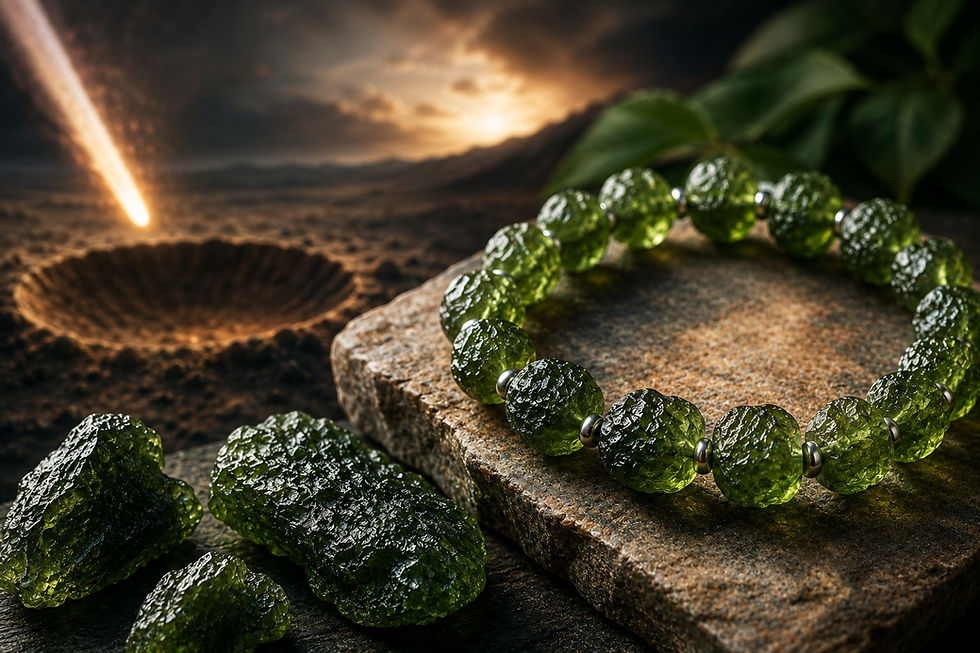
Moldavite is not an ordinary crystal. It is a natural glass created when intense impact energy melted terrestrial material and ejected molten material through the atmosphere. The molten droplets cooled rapidly before reaching the ground.
This unusual origin explains why genuine Moldavite often looks different from ordinary glass.
The material can display an olive-green, moss-green, bottle-green, or darker green appearance. Individual specimens can vary considerably in shape, thickness, transparency, and surface texture.
The surface is especially important when examining a raw specimen. Genuine Moldavite can have pits, grooves, wrinkles, ridges, and irregular etched areas. These characteristics do not follow a simple repeating pattern.
However, no single characteristic proves authenticity by itself. Color can be copied. Shape can be copied. Even surface texture can be artificially reproduced.
The strongest approach is to examine several characteristics together.
That brings us to the first sign.
Six Signs That Can Help You Identify Real Moldavite
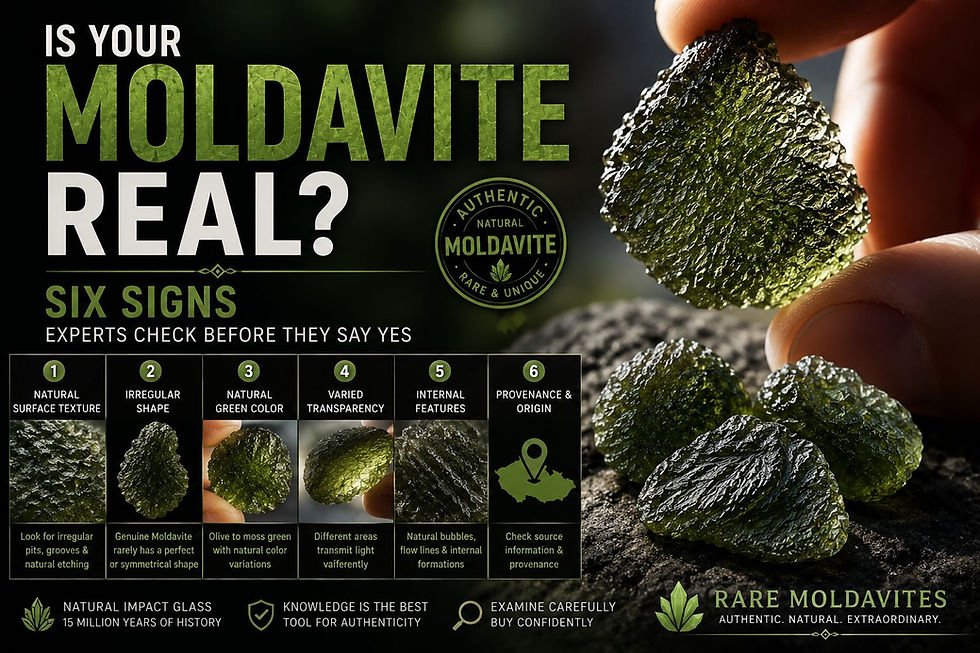
1. Examine the Natural Surface Texture
Surface texture is one of the first things experienced collectors examine when trying to how to identify moldavite.
A natural Moldavite specimen can have a complex surface created through its formation and later geological alteration. The texture may include small pits, grooves, ridges, wrinkles, depressions, and irregular etched areas.
The key word is variation.
Natural Moldavite does not usually display a perfectly repeated texture across the entire surface. Different areas can look noticeably different when you rotate the specimen.
Fake Moldavite made from manufactured glass may show patterns that look too uniform. Some imitation pieces have repeated grooves or similar markings across multiple areas because the material came from a mold.
What should you look for?
Hold the specimen under good natural light and rotate it slowly.
Look at several areas instead of focusing on one attractive section. Check whether the texture changes naturally across the surface.
A genuine-looking specimen should show complexity rather than a simple repeated design.
A common mistake is expecting every authentic Moldavite to have deep, dramatic ridges. Natural specimens vary. Some pieces have strong surface relief, while others have a finer or more weathered appearance.
Surface texture is a clue, not a standalone certificate of authenticity.
Transition: Once the surface looks natural, the next step is to examine the specimen's overall shape.
2. Look at the Shape and Overall Form
Shape provides another useful clue when learning how to identify real moldavite.
Natural Moldavite specimens are usually irregular. Their outlines can contain curves, protrusions, depressions, broken edges, and uneven sections.
A perfectly symmetrical piece should make you look more closely.
That does not mean symmetry automatically proves a specimen is fake. Natural processes can occasionally produce shapes that appear relatively balanced. The important point is that Moldavite does not normally form with the controlled symmetry associated with manufactured products.
Think about a natural stone compared with a molded object.
A naturally formed stone develops through geological processes that do not follow a factory template. A manufactured glass imitation can begin with a mold that gives multiple pieces very similar outlines.
Try this simple observation
Place the specimen against a plain background.
Rotate it slowly and examine the outline from different angles. Look for natural irregularity rather than judging the specimen from only one side.
Also examine the edges. Raw Moldavite can have uneven edges and changes in thickness.
If several supposedly unrelated pieces have nearly identical shapes, investigate further.
Shape becomes more useful when combined with surface texture, transparency, color, and internal features.
Transition: After checking the outer form, examine how light travels through the specimen.
3. Watch How Light Passes Through the Moldavite
Transparency is another useful feature in the fake vs real moldavite comparison.
Hold the specimen near natural daylight and slowly rotate it.
Different parts of a natural specimen can transmit light differently because thickness changes throughout the piece. Thin edges may appear lighter or more translucent, while thicker areas can look darker.
This creates visual variation.
A specimen that looks completely uniform under light deserves closer inspection, especially when other characteristics also appear artificial.
However, transparency should never be treated as a laboratory test. A thick natural Moldavite specimen can look dark, while a thin specimen can allow considerable light through.
The goal is to observe how the material behaves as you change its position.
A simple light test
Hold the specimen near a bright window or use natural daylight.
Rotate the specimen slowly.
Examine thin edges and thicker sections.
Look for changes in light transmission.
Compare several areas rather than judging one spot.
This process can reveal differences that are difficult to see in a static photograph.
A common mistake is judging Moldavite only by how bright green it looks. Lighting can dramatically change perceived color and transparency.
Transition: Once you understand the light behavior, color becomes a more useful supporting clue.
4. Check the Color Without Trusting Color Alone
Genuine Moldavite is famous for its green color.
Common natural shades include olive green, moss green, bottle green, and darker green tones. Some specimens appear lighter because they are thinner or receive stronger light.
Color can help you evaluate a specimen, but color alone cannot establish authenticity.
This point matters because green glass is widely available. A manufactured glass piece can have an attractive green color that looks convincing in a photograph.
Very bright, highly uniform, emerald-like green should encourage closer examination. That does not automatically mean the specimen is fake, but it means you should check the other characteristics carefully.
Why does color vary?
Moldavite formed as natural impact glass. Its chemical composition, thickness, lighting conditions, and internal structure all influence its appearance.
Two genuine specimens can look noticeably different.
This is why how to identify genuine moldavite should never become a simple color-matching exercise.
When examining a specimen, ask:
Does the color vary naturally with thickness?
Does the specimen show different green tones under changing light?
Does the surface have natural-looking variation?
Does the shape look naturally irregular?
Does the internal structure look consistent with natural glass?
The more independent characteristics that agree, the stronger your overall assessment becomes.
Transition: Color gives you context, but the interior can provide another important layer of information.
5. Examine Internal Features and Inclusions
When learning how to tell real moldavite, do not focus only on the outside.
Natural Moldavite can contain internal features that become visible when light passes through thinner areas. Depending on the specimen, you may notice variations, wispy structures, small bubbles, or other internal characteristics.
These features should be interpreted carefully.
People sometimes assume that every bubble proves a piece is fake. That is not a reliable rule. Natural impact glass can contain internal features, and manufactured glass can also contain bubbles.
The important question is not whether you see one bubble.
The important question is whether the entire specimen shows a collection of characteristics consistent with natural Moldavite.
Use magnification if available, but start with your eyes. Look through thinner sections and rotate the specimen under natural light.
What should you avoid?
Do not assume that one internal feature automatically proves authenticity.
Do not assume that a perfectly clear specimen is fake.
Do not assume that bubbles automatically prove authenticity.
Authentication becomes stronger when multiple physical observations point in the same direction.
This is where careful examination becomes more useful than internet shortcuts.
Transition: The final sign brings all the previous observations together and focuses on the specimen's origin and documentation.
6. Check Provenance and the Complete Specimen Story
Physical appearance matters, but provenance can provide important supporting information.
Provenance means the documented history or origin information associated with a specimen. For Moldavite, useful information can include where the material was obtained, whether locality information is available, photographs of the actual specimen, and details about how the material was identified.
A seller who provides clear information gives the buyer more context for evaluating the piece.
This is particularly important when a specimen has unusual characteristics or a high claimed level of rarity.
Ask these questions
Is the specimen described as natural Moldavite?
Is the geographical origin clearly stated?
Are the photographs of the actual specimen?
Does the description explain the specimen's characteristics?
Does the seller understand Moldavite rather than simply selling generic green glass?
Can the seller explain how the specimen was sourced?
Clear answers do not replace professional testing when authentication is critical. They do, however, help you avoid making a decision based only on a photograph or marketing description.
At Rare Moldavites, the focus should remain on helping collectors understand the natural characteristics, origin, and authenticity considerations associated with Moldavite.
Transition: These six signs become much more useful when you examine them together instead of treating each clue as a separate verdict.
How to Identify Real Moldavite Without Special Equipment
Many people ask whether they need a microscope or laboratory equipment to identify Moldavite.
For an initial inspection, you can learn a great deal using simple tools.
The basic process is straightforward.
Step 1: Find natural daylight
Place the specimen near a window or examine it outdoors in indirect daylight. Strong natural light makes surface details and transparency easier to observe.
Step 2: Rotate the specimen
Do not inspect only one side. Slowly rotate the piece and observe its shape, texture, color, and light transmission from multiple angles.
Step 3: Study the surface
Look for naturally varied pits, grooves, ridges, and etched areas. Repeated patterns deserve closer attention.
Step 4: Check the shape
Look for natural irregularity. Avoid assuming that every attractive or symmetrical green glass piece is Moldavite.
Step 5: Examine transparency
Watch how different sections transmit light. Thickness should influence the appearance of the specimen.
Step 6: Inspect internal features
Look through thinner areas and examine any visible internal structures.
Step 7: Review provenance
Compare the physical characteristics with the available origin and sourcing information.
This process will not replace professional authentication for every specimen. It does provide a sensible first-level examination.
Real vs Fake Moldavite: The Most Common Mistakes
The biggest mistake is relying on one feature.
Someone may see green color and assume the specimen is genuine. Another buyer may see a rough surface and immediately accept it as authentic. Both approaches can fail.
The real vs fake moldavite comparison works better when several characteristics are evaluated together.
Another common mistake is trusting photographs without asking for images of the actual piece. Lighting, filters, reflections, and camera settings can change how green glass appears.
A third mistake is assuming that unusual texture automatically means authenticity. Manufactured glass can also be textured.
A fourth mistake is using price as an authenticity test. Expensive does not automatically mean genuine, and an affordable specimen is not automatically fake.
The better approach is evidence.
Examine the physical specimen. Study its surface. Check its shape. Observe transparency. Look at internal characteristics. Then consider provenance.
This problem has a simple cause and solution:
Problem: Green glass can resemble Moldavite.
Cause: Color and general appearance are easy to imitate.
Solution: Evaluate multiple independent characteristics together.
That approach gives collectors a much stronger starting point.
A Practical Example: Examining a Green Specimen
Imagine you receive a raw green specimen and want to know whether it deserves further investigation.
At first glance, the piece has a strong green color. That tells you very little.
You place the specimen under natural light. The color changes slightly as you rotate it. Some sections appear darker because they are thicker.
Next, you inspect the surface. One side contains deep irregular grooves, while another side has smaller pits and a different texture.
The outline is also uneven. No two sides look identical.
You then examine the piece through a bright area. Internal variations become visible in the thinner sections.
Finally, you review the available origin information.
No single observation proves authenticity. However, the combined evidence provides a much stronger basis for deciding whether the specimen deserves further examination or professional authentication.
This is the mindset collectors should develop.
Instead of asking, "Does this look like Moldavite?" ask, "Do several independent characteristics agree with a natural Moldavite origin?"
That is a much better question.
Why Magnification Can Help
A loupe or magnifying glass can make small surface features easier to inspect.
Magnification does not magically identify Moldavite. It simply allows you to see details that may be difficult to notice with the naked eye.
Under magnification, you can examine:
Fine surface pits
Small ridges
Etched areas
Texture changes
Edge characteristics
Internal features visible near thin sections
A 10x loupe is often enough for close visual inspection.
However, avoid treating magnification as a guaranteed authenticity test. A skilled imitator can create textured glass, and natural specimens can vary considerably.
The strongest method remains a combination of visual examination, provenance, knowledgeable evaluation, and professional testing when necessary.
What Makes Authentic Moldavite Different?
Authentic Moldavite has a geological story that manufactured green glass cannot reproduce.
The material formed during a major meteorite impact event approximately 15 million years ago. That event produced natural impact glass with characteristics influenced by extreme heat, rapid cooling, atmospheric travel, and later geological processes.
This history helps explain the unusual appearance of Moldavite.
The surface can look almost sculpted. The shape can be irregular. The color can shift with thickness. Internal features can add another layer of visual complexity.
These characteristics make Moldavite particularly interesting to mineral collectors.
In my experience, one of the most useful habits for new collectors is slowing down. Do not make a decision after seeing the color or one attractive texture. Rotate the specimen. Examine the entire surface. Compare multiple characteristics.
That simple change in approach can help you make better-informed decisions.
How Rare Moldavites Helps Collectors Understand Authenticity
Rare Moldavites focuses on education around natural Moldavite, including its appearance, origin, identification, and characteristics that collectors commonly examine.
The goal is not to reduce authenticity to a single visual trick.
Moldavite is a natural geological material. Natural materials show variation. That variation is part of what makes each specimen interesting.
When examining Moldavite, collectors should therefore focus on the complete picture.
Look at the texture.
Look at the shape.
Look at transparency.
Look at color.
Look at internal characteristics.
Then consider provenance.
This method creates a more informed understanding of authentic moldavite than relying on a single online photograph or a simple "test."
Expert Authority Note
According to the Smithsonian National Museum of Natural History, tektites are natural glasses associated with meteorite impacts, and their characteristics reflect the extreme conditions involved in their formation. Moldavite belongs to this broader tektite group and is recognized for its distinctive green appearance and impact-related geological origin. For difficult or high-value authentication questions, examination by a qualified mineral or gem professional remains the appropriate next step.
Frequently Asked Questions
How do I know if my Moldavite is real?
The best way to assess Moldavite authenticity is to examine several characteristics together. Look for an irregular natural shape, varied surface texture, natural green coloration, changes in transparency, and internal features that appear consistent with natural impact glass. Provenance also matters because information about origin and sourcing can support the physical observations. No single visual feature should be treated as absolute proof of authenticity.
What is the best way to identify real Moldavite without equipment?
The best way to identify real Moldavite without equipment is to use natural daylight and carefully examine the complete specimen. Rotate the piece slowly and check the surface, shape, color, transparency, and internal appearance from multiple angles. Genuine Moldavite often shows natural variation rather than perfectly repeated patterns. A visual inspection can provide useful clues, but professional authentication remains appropriate when certainty is essential.
How can I tell fake Moldavite from real Moldavite?
You can compare several characteristics when trying to distinguish fake Moldavite from real Moldavite. Manufactured green glass may show overly uniform color, repeated surface patterns, or shapes that appear too consistent, while natural Moldavite commonly shows irregular texture and changes in thickness. These observations are clues rather than absolute tests, so provenance and professional evaluation can provide additional confidence.
What does genuine Moldavite look like?
Genuine Moldavite commonly has an olive-green, moss-green, bottle-green, or darker green appearance with natural variation across the specimen. Raw pieces can have irregular shapes and complex surfaces containing pits, grooves, ridges, and etched areas. Transparency can also change according to thickness. Genuine Moldavite does not need to look identical to another authentic specimen because natural geological materials vary from piece to piece.
Can a magnifying glass tell you if Moldavite is real?
A magnifying glass can help you examine Moldavite more closely, but magnification alone cannot prove authenticity. A loupe can reveal small pits, ridges, etched areas, edge details, and internal features that are harder to see with the naked eye. The most useful approach is to combine magnified observations with shape, color, transparency, provenance, and other physical characteristics.
What is the biggest mistake people make when identifying Moldavite?
The biggest mistake is relying on one characteristic as proof of authenticity. Color alone is not enough because green glass can imitate Moldavite, while surface texture alone can also be misleading. Buyers and collectors should examine the entire specimen and consider several independent characteristics together. This approach reduces the risk of accepting an imitation simply because one feature appears convincing.
How can I identify genuine Moldavite before buying it?
Before buying Moldavite, examine photographs of the actual specimen rather than relying only on generic product images. Ask about origin, sourcing, natural characteristics, and whether the material is genuine Czech Moldavite. Study the surface texture, shape, color, transparency, and internal features shown in the photographs. For an important or expensive acquisition, independent professional authentication provides a stronger level of verification than visual inspection alone.
Key Takeaways
Examine several characteristics together instead of trusting color alone.
Natural surface variation is an important feature to inspect on raw Moldavite.
Irregular shapes and changing thickness can provide useful authenticity clues.
Natural daylight makes color, transparency, and surface details easier to evaluate.
Provenance and sourcing information should support the physical characteristics.
Professional authentication is the safest option when certainty is critical.
Conclusion
Learning how to identify moldavite starts with careful observation rather than a single quick test. Genuine Moldavite can show natural surface variation, irregular shapes, changing transparency, distinctive green coloration, and internal characteristics associated with natural impact glass.
The most important lesson is to look at the complete specimen. A single feature can be misleading, but several consistent characteristics provide a much stronger basis for evaluation.
If you are learning how to identify real moldavite or how to identify genuine moldavite, take your time and examine the specimen from different angles and under natural light. Continue learning about Moldavite's geological origin, natural textures, and identification methods through Rare Moldavites.


Comments