
Is Moldavite Running Out? The Hard Truth About Czech Mine Depletion

QUICK ANSWER BOX
Is Moldavite running out? The short answer is yes—but not in the way many headlines suggest. Genuine Czech Moldavite formed during a single meteorite impact approximately 14.8 million years ago, meaning no new natural supply will ever be created. While authentic Moldavite is still available, premium specimens from famous Czech localities are becoming increasingly difficult to source, making quality pieces significantly more desirable among collectors.
INTRODUCTION
Few questions have spread through the mineral collecting community faster than "Is Moldavite running out?" It is a question that appears everywhere—from collector forums and auction websites to geology discussions and social media groups. Some people claim Moldavite will disappear within a few years. Others believe there is still an unlimited supply waiting beneath Czech farmland. The reality sits somewhere between those two extremes, and understanding it requires separating geological fact from internet speculation.
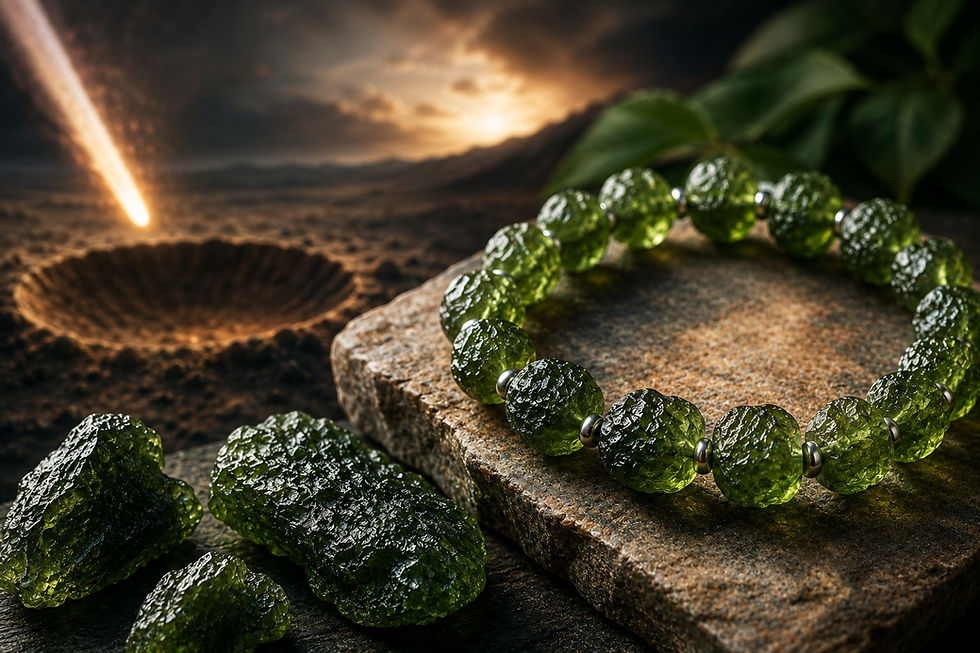
The Moldavite is defined as a natural impact glass created approximately 14.8 million years ago when a massive meteorite struck what is now the Ries Crater in southern Germany. The tremendous impact melted surrounding rocks before launching molten material high into the atmosphere, where it cooled rapidly and eventually landed across parts of modern-day Czech Republic. Unlike gemstones that continue forming beneath the Earth's crust, Moldavite originated during one extraordinary event that will never naturally happen again. Every authentic specimen available today therefore comes from a finite geological source.
As someone who has spent years studying collector-grade Czech Moldavite and working alongside buyers searching for exceptional specimens, I have noticed that the biggest misunderstanding is not whether Moldavite exists—it clearly does—but rather how remaining supplies are changing. Many first-time collectors imagine enormous untouched deposits still waiting to be discovered. Experienced collectors understand that the situation is far more complex. Legal mining restrictions, exhausted historical localities, increasing international demand, and the growing popularity of premium specimens have all changed the market dramatically.
Who This Is For: Whether you collect rare minerals, invest in geological specimens, enjoy Czech natural history, or simply want to understand the future of authentic Moldavite, this guide explains exactly what is happening beneath the surface and why serious collectors are paying close attention.
Throughout this article, you'll discover what geology tells us about Moldavite depletion, why certain Czech localities have become extraordinarily valuable, how collector demand continues to reshape the market, and what buyers should know before purchasing authentic Moldavite in 2026.
TABLE OF CONTENTS
Why Moldavite Supply Is Naturally Limited
The Geological Truth Behind Czech Moldavite Mines
Why Some Localities Are Already Becoming Scarce
How Collector Demand Is Accelerating Market Changes
Common Myths About Moldavite Depletion
Should You Buy Moldavite Before Supplies Tighten Further?
How to Buy Genuine Czech Moldavite with Confidence
Why Moldavite Supply Is Naturally Limited
The question "Is Moldavite running out?" can only be answered properly by first understanding how Moldavite was created. Unlike traditional gemstones such as emerald, sapphire, quartz, or topaz, Moldavite is not a mineral that slowly crystallised beneath the Earth's surface over millions of years. Instead, it belongs to an entirely different geological category known as a tektite—natural glass created by one of the most violent events in planetary history.
Approximately 14.8 million years ago, a massive asteroid travelling at extraordinary speed collided with the Earth near what is now the Ries Crater in southern Germany. The energy released during this impact exceeded anything humanity has ever produced naturally or artificially. Temperatures instantly rose high enough to melt enormous volumes of surrounding rock, sending molten droplets thousands of metres into the atmosphere. As those droplets cooled during flight, they solidified before falling across areas that now form part of the Czech Republic.
That single event created every authentic Moldavite known today. This geological fact is incredibly important because it means nature will never create another supply of Czech Moldavite. Unlike gemstones that continue forming deep underground through ongoing geological activity, Moldavite represents a completely fixed resource. Every specimen purchased by collectors today originates from material created during one moment in Earth's distant past. Once existing deposits have been recovered, no natural process exists to replace them.
Many online articles simplify this idea by saying Moldavite is "rare," but rarity alone does not explain its collector value. Plenty of minerals are rare. What makes Moldavite fundamentally different is that scientists know exactly when, how, and where it formed. Its supply has remained fixed for nearly fifteen million years, while worldwide demand continues to grow each year. This imbalance between permanent geological limits and increasing collector interest forms the foundation of today's market.
As demand grows internationally, attention naturally shifts toward the Czech Republic itself, where every authentic Moldavite originates. Understanding what is happening inside these historic collecting regions provides the clearest answer to whether Moldavite is genuinely becoming harder to obtain.
The Geological Truth Behind Czech Moldavite Mines
When people hear the phrase "Czech Moldavite mines," many imagine enormous commercial mining operations continuously producing fresh Moldavite every year. In reality, the situation is considerably different. Moldavite has never been extracted on the same industrial scale as precious metals or commercial gemstones. Instead, most authentic specimens have historically been recovered from relatively small deposits scattered across southern Bohemia and parts of southern Moravia, often discovered during gravel extraction, agricultural work, or carefully controlled excavation projects.
Several famous localities have already earned legendary status among collectors. Besednice, Chlum, Slavče, Radomilice, and a handful of neighbouring areas have produced some of the world's finest Moldavite specimens. Each locality possesses its own distinctive geological characteristics, resulting in differences in colour, natural sculpture, surface texture, translucency, and overall collector appeal. Experienced collectors can often recognise the origin of a specimen simply by examining its natural weathering patterns.
The challenge facing today's market is not that Czech Moldavite has suddenly disappeared overnight. Rather, many historically productive areas have already yielded much of their accessible material. Decades of legal collecting, natural erosion, commercial excavation, and increasing global interest have gradually reduced the availability of premium specimens. In some locations, land-use changes and environmental protections have further limited opportunities for recovering new material.
This gradual tightening of supply has had an important effect on collector behaviour. Instead of waiting for abundant new discoveries, experienced buyers increasingly compete for well-preserved specimens already circulating within established collections. High-quality Moldavite has become less about finding newly unearthed pieces and more about recognising exceptional examples before another collector does.
Understanding this shift helps explain why prices have continued rising, particularly for museum-grade material from famous Czech localities. However, limited mining alone does not fully explain today's collector market. Another equally important factor is changing demand, which has grown faster than many experts expected.
Why Some Localities Are Already Becoming Scarce
Not all Moldavite is equally rare. Although every authentic specimen shares the same remarkable cosmic origin, the locality where it was discovered plays a significant role in determining both its collector appeal and its long-term value. This is one of the biggest misconceptions among new buyers. Many assume that all Czech Moldavite is essentially the same, differing only in size or weight. In reality, experienced collectors often place locality above weight because each historic field has produced its own distinctive characteristics that can never be replicated elsewhere.
The Moldavite is defined as a locality-sensitive collectible, meaning that where it was found directly influences its desirability. Besednice, Chlum, Slavče, Radomilice, and several South Bohemian localities have each developed their own reputation over decades of geological study and collector experience. Besednice is particularly admired for its dramatic "hedgehog" textures, intricate natural sculpture, and deeply etched surfaces. Chlum specimens often display different sculptural qualities, while other localities offer their own subtle variations in colour, shape, and weathering. These differences are entirely natural, created over millions of years through geological processes, making every locality part of the specimen's identity.
What makes these famous locations especially important today is that many are no longer producing material in the quantities they once did. Years of legal recovery, changing land use, environmental protections, and the natural exhaustion of productive areas have reduced the number of premium specimens entering the market. While authentic Moldavite is still available, finding museum-quality examples from the most respected localities has become considerably more challenging than it was twenty or thirty years ago.
This gradual reduction does not mean collectors should panic or assume that Moldavite will suddenly disappear. Instead, it highlights a natural progression seen in many respected mineral markets. As exceptional specimens become more difficult to replace, collectors begin placing greater emphasis on quality rather than quantity. That shift explains why beautifully preserved locality pieces consistently outperform ordinary examples in terms of collector interest.
A useful way to understand this is to compare Moldavite with rare first-edition books. Millions of books may exist, but only a small number belong to the earliest printing, remain in outstanding condition, and carry historical significance. Those specific copies naturally become the most desirable. Moldavite behaves in much the same way. Every specimen is genuine geological history, but locality, preservation, and natural beauty determine which pieces eventually become the centrepieces of advanced collections. Understanding locality scarcity leads naturally to another important question. If supplies are tightening gradually rather than disappearing overnight, why has collector demand increased so dramatically over recent years?
How Collector Demand Is Accelerating Market Changes
Supply tells only half the story of the Moldavite market. The other half is demand, and this is where the biggest changes have occurred during the past decade. Although Moldavite has been appreciated by mineral collectors for generations, interest has expanded far beyond traditional geological circles. Today, museums, gemstone collectors, jewellery enthusiasts, investors in rare natural objects, and people fascinated by Earth's impact history all compete for the same finite resource.

The Moldavite is defined as one of the few natural materials that combines scientific importance, historical significance, visual beauty, and genuine rarity within a single collectible. That combination is exceptionally uncommon. Many minerals possess attractive colours. Others have fascinating geological histories. Very few successfully combine both while also existing in permanently limited quantities. As awareness has grown internationally, so has competition for the finest examples.
In my experience working with collectors, the biggest change has not been the arrival of new buyers but the changing behaviour of experienced ones. Years ago, many collectors were content simply owning a piece of Moldavite. Today, those same collectors actively search for better specimens from respected localities, replacing ordinary examples with stones displaying stronger natural sculpture, clearer provenance, and superior preservation. This process steadily removes premium material from the open market because collectors rarely sell exceptional pieces once they become part of a carefully built collection.
Another factor driving demand is education. Reliable geological information has become easier to access than ever before. Buyers now understand why locality matters, how natural surface textures develop, why provenance adds value, and what separates museum-grade specimens from average examples. Better-informed collectors naturally make more selective purchases, increasing competition for outstanding material while leaving lower-quality specimens behind.
This changing market also explains why price alone should never guide a purchasing decision. Two specimens of identical weight may differ dramatically in collector value because one possesses exceptional geological character while the other does not. As knowledge spreads, the market increasingly rewards quality over simple size, benefiting buyers who invest time in understanding what truly makes one specimen more desirable than another.
At Rare Moldavites, we have seen this shift firsthand through conversations with collectors around the world. Increasingly, buyers ask detailed questions about locality, natural surface texture, geological history, and provenance rather than simply requesting the lowest available price. That evolution reflects a healthier, more knowledgeable collector community and reinforces why authentic Czech Moldavite continues to command growing respect within the international mineral market. As collector demand continues to strengthen alongside naturally limited supply, the conversation moves beyond whether Moldavite is becoming scarce. The more important question becomes how buyers can make informed decisions in a market where exceptional specimens are increasingly difficult to replace.
Common Myths About Moldavite Depletion
As conversations about is moldavite running out continue to grow, so do the myths surrounding the subject. Some claims contain a small amount of truth, while others spread rapidly without any geological evidence. For collectors, understanding the difference between fact and speculation is essential because purchasing decisions should be based on reliable information rather than sensational headlines.
The Moldavite is defined as a finite natural impact glass, but finite does not mean extinct. One of the most common myths suggests that there is no Moldavite left anywhere in the Czech Republic. That simply is not accurate. Authentic Moldavite continues to enter the market through established collections, carefully sourced legal recovery, and reputable dealers. However, what has changed is the availability of exceptional collector-grade material. Finding museum-quality specimens today requires considerably more patience than it did decades ago because the finest examples are becoming increasingly difficult to replace.
Another misunderstanding is that every remaining Moldavite specimen will automatically become extremely valuable. Rarity alone does not determine collector value. Experienced buyers evaluate multiple characteristics together, including locality, natural surface sculpture, preservation, transparency, colour, dimensions, and overall visual appeal. Two authentic Czech Moldavites may weigh exactly the same, yet one may command several times the value because it displays superior geological features or originates from a highly respected locality such as Besednice.
A third myth claims that all current Moldavite prices are artificially inflated. While speculation exists in almost every collectible market, premium Moldavite prices are supported by genuine geological scarcity and sustained international demand. Unlike manufactured collectibles, additional authentic Moldavite cannot simply be produced to satisfy buyers. Every specimen entering the market today comes from the same finite geological event that occurred approximately 14.8 million years ago.
Perhaps the most dangerous misconception is believing that any inexpensive green glass advertised online represents an incredible bargain. Unfortunately, the popularity of Moldavite has encouraged the production of numerous counterfeit products. Artificial glass may imitate the colour of Moldavite, but it cannot reproduce millions of years of natural weathering, authentic surface sculpture, or documented Czech provenance. Serious collectors understand that transparency from the seller is often just as valuable as the specimen itself. When collectors move beyond internet myths and focus on verified geological facts, they begin making decisions based on quality rather than fear. That approach naturally raises another important question: should buyers act now, or is there still time to build a meaningful collection?
Should You Buy Moldavite Before Supplies Tighten Further?
Every collector eventually reaches the same decision point. After learning about Moldavite's remarkable geological history and understanding the realities of limited supply, the question becomes whether purchasing today makes sense or whether waiting is equally reasonable.
The answer depends less on predicting future prices and more on understanding collector priorities. The Moldavite is defined as a finite geological collectible whose long-term appeal comes from rarity, scientific significance, and natural beauty rather than short-term market speculation. Buyers who appreciate those qualities generally approach the market differently from those searching only for rapid financial gains.
In my experience, collectors who consistently build exceptional collections share one common habit. They purchase outstanding specimens when they encounter them rather than hoping similar examples will appear later. Museum-grade Moldavite rarely follows predictable availability. A beautifully preserved Besednice specimen with remarkable natural sculpture may become available only occasionally, and once purchased by an experienced collector, it often disappears into a private collection for many years.
Waiting also carries an opportunity cost that many first-time buyers overlook. As premium specimens become more difficult to source, collectors often find themselves choosing between fewer available examples rather than enjoying broader selection. The challenge is not necessarily that prices increase dramatically overnight, but that exceptional quality becomes increasingly difficult to replace. When a remarkable specimen leaves the market, there is no guarantee another comparable piece will appear soon.
This does not mean buyers should rush into purchases without proper research. Quite the opposite. Careful evaluation remains essential. Understanding locality, natural preservation, provenance, and geological characteristics helps ensure every acquisition reflects genuine collector value rather than temporary market excitement.
Collectors who combine patience with preparation usually achieve the best results. They study the market, learn the differences between localities, recognise exceptional natural sculpture, and purchase confidently when the right opportunity appears. That balanced approach has served experienced Moldavite enthusiasts well for decades and continues to remain relevant in 2026.
How to Buy Genuine Czech Moldavite with Confidence
Buying authentic Czech Moldavite should feel like acquiring a remarkable piece of Earth's geological history, not solving a mystery. While increasing popularity has introduced more sellers into the market, it has also made careful research more important than ever. Fortunately, a few simple principles can help buyers make informed decisions while avoiding unnecessary risks.
The first step is understanding the individual specimen rather than focusing only on its weight or price. Every authentic Moldavite is unique. Surface texture, natural sculpture, translucency, preservation, and locality all contribute to collector value. Experienced buyers spend time examining photographs of the exact specimen because no two pieces display identical geological characteristics. Strong natural etching, well-preserved surface detail, and balanced proportions often indicate higher-quality collector material.
Locality should also receive careful attention. Famous Czech collecting areas such as Besednice, Chlum, Slavče, and Radomilice have each earned their own reputation within the mineral collecting community. Knowing where a specimen originated provides valuable context that extends beyond simple curiosity. It helps explain why certain pieces command stronger collector interest and why locality often influences long-term desirability.
Transparency from the seller remains another essential consideration. Reputable specialists openly discuss geological origin, locality, dimensions, natural characteristics, and provenance. Rather than relying on exaggerated marketing language, they educate buyers about why a particular specimen is significant. This educational approach builds confidence and allows collectors to appreciate the true value of their purchase.
Equally important is avoiding decisions based solely on unusually low prices. Genuine Czech Moldavite represents a finite natural resource with established international demand. While fair pricing certainly exists, offers that appear dramatically below typical collector values deserve careful examination. Exceptional specimens rarely become available through unrealistic discounts because experienced collectors recognise their significance.
Ultimately, buying genuine Moldavite is about understanding the story behind the stone. When collectors focus on authenticity, locality, natural beauty, and geological significance, they build collections that remain meaningful regardless of short-term market fluctuations.
According to the Czech Geological Survey and research published by the Geological Institute of the Czech Academy of Sciences, Moldavite formed during the Ries meteorite impact approximately 14.8 million years ago, making it one of the world's few naturally occurring impact glasses with a well-documented geological origin. Scientific studies confirm that authentic Moldavite occurs only within specific Czech strewn fields, reinforcing why locality, finite supply, and natural preservation continue to play a central role in collector value. This geological evidence supports what experienced collectors have recognised for decades: premium Czech Moldavite represents a genuinely limited natural resource rather than a material that can be replenished through future mining.
Frequently Asked Questions
Is Moldavite really running out, or is it just a marketing claim?
Yes, authentic Moldavite is becoming increasingly scarce, but that does not mean it has completely disappeared. The reason is geological rather than promotional. Moldavite was created during a single meteorite impact approximately 14.8 million years ago, meaning nature will never produce another supply. While genuine Czech Moldavite continues to enter the market through established collections and carefully sourced legal recovery, premium specimens from famous localities such as Besednice and Chlum are becoming noticeably harder to replace. This tightening supply explains why experienced collectors focus on exceptional quality whenever an outstanding specimen becomes available.
Why are some Czech Moldavite localities more valuable than others?
Certain Czech localities are more valuable because they produce distinctive natural characteristics that collectors cannot find elsewhere. Besednice, for example, is internationally recognised for its remarkable hedgehog-like surface sculpture and deeply etched natural texture, while other localities produce different geological features. Locality becomes part of a specimen's identity, much like the origin of a famous vintage wine or historical artwork. As production from respected collecting areas has declined over time, well-preserved specimens from these localities have become increasingly desirable among advanced collectors who appreciate geological rarity as well as visual beauty.
Should I buy Moldavite now or wait for prices to fall?
For collectors purchasing Moldavite because of its geological significance and rarity, waiting is not always the best strategy. Nobody can predict future prices with certainty, but one reality remains constant: exceptional specimens become more difficult to replace as time passes. When a museum-grade Moldavite enters a private collection, it may remain there for decades before returning to the market. Rather than trying to perfectly time prices, experienced collectors usually concentrate on finding outstanding locality, strong natural preservation, and genuine provenance. Buying the right specimen generally matters far more than attempting to predict short-term market movements.
How can I avoid buying fake Moldavite online?
The safest approach is to purchase from specialists who provide complete transparency about every specimen they offer. Authentic Moldavite should be accompanied by detailed information describing its Czech locality, dimensions, natural characteristics, and photographs of the exact piece being sold. Counterfeit glass often appears unusually bright, perfectly smooth, or identical across multiple listings, while genuine Moldavite displays naturally weathered textures that vary from specimen to specimen. Taking time to research both the seller and the individual stone dramatically reduces the likelihood of purchasing an imitation.
Does Moldavite scarcity automatically make every specimen valuable?
No. Scarcity alone does not determine collector value because every specimen possesses different geological characteristics. Two authentic Moldavite pieces may weigh exactly the same yet differ substantially in desirability because one displays exceptional natural sculpture, outstanding preservation, or originates from a highly respected Czech locality. Experienced collectors evaluate several qualities simultaneously, including locality, surface texture, transparency, proportions, condition, and provenance. The combination of these characteristics ultimately determines why certain specimens command significantly stronger prices than others.
What is the best way to build a valuable Moldavite collection?
The most successful collections are usually built patiently, with an emphasis on quality rather than quantity. Instead of purchasing numerous average specimens, experienced collectors often prefer acquiring fewer pieces that display exceptional geological character, respected locality, and excellent preservation. Over time, a carefully selected collection becomes far more rewarding than one assembled quickly without attention to detail. Learning about Czech localities, understanding natural surface formations, and choosing authentic specimens from trusted specialists creates a collection with lasting geological and historical significance.
CONCLUSION
The question "Is Moldavite running out?" deserves a thoughtful answer rather than a dramatic headline. Authentic Czech Moldavite is not disappearing overnight, but the reality is that it originates from a single geological event that can never be repeated. Combined with decades of careful recovery, increasing worldwide demand, and limited availability from respected Czech localities, this fixed supply has naturally made exceptional specimens more difficult to replace.
For collectors, the real opportunity is not simply buying Moldavite before someone else does. It is understanding what separates an ordinary specimen from an extraordinary one. Locality, natural sculpture, preservation, provenance, and geological history all contribute to lasting collector appeal. By focusing on those qualities, buyers can build collections that remain meaningful for generations.
If you would like to learn more about authentic Czech Moldavite, explore the educational resources and carefully curated specimens available through Rare Moldavites. The right knowledge is every bit as valuable as the stone itself.


Comments