
How to Identify Genuine Moldavite: An Accurate Collector Guide

Knowing how to identify genuine Moldavite has become essential for collectors and serious buyers. As demand increases and natural Czech deposits decline, fake Moldavite made from industrial glass has flooded online markets. Without proper knowledge, even experienced buyers can make costly mistakes.
This guide explains, step by step, how experts distinguish real Moldavite from imitations using geological facts, surface characteristics, origin verification, and practical inspection methods.
Why Identifying Genuine Moldavite Matters
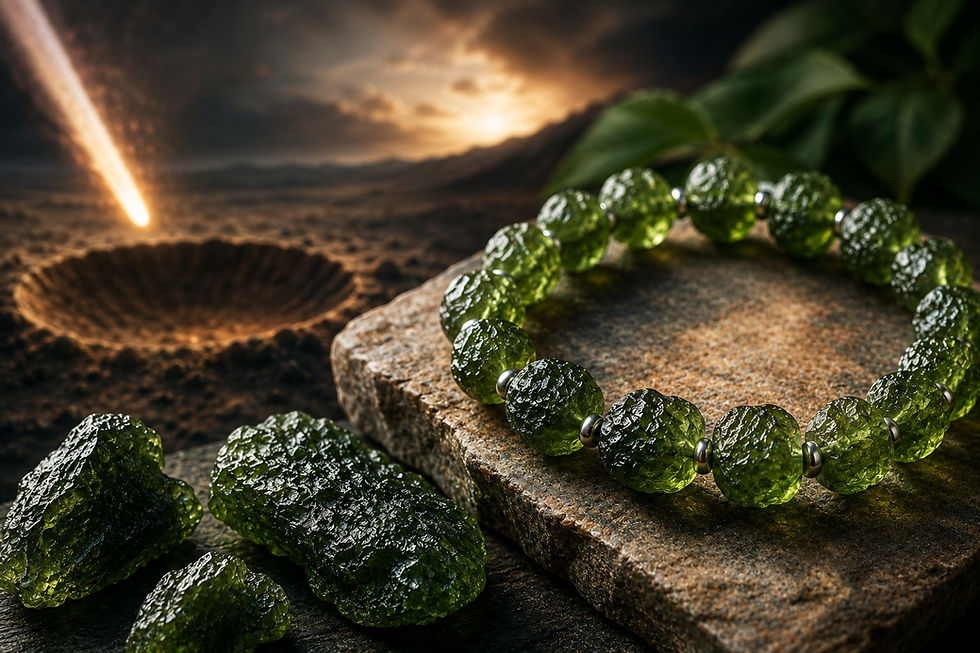
Moldavite is not just a green stone. It is a natural tektite, formed during a single meteor impact event that occurred nearly 15 million years ago near the Ries Crater in present-day Germany. Material ejected from that impact landed only in specific Czech regions.
Because this event happened once and can never repeat, no new Moldavite will ever form. Every genuine piece is finite, making authenticity critical for value, science, and collecting integrity.

Understand the True Origin First
The most reliable way to identify genuine Moldavite is understanding where it comes from.
Authentic Moldavite exists only in the Czech Republic, primarily in:
Southern Bohemia
Moravia
Moldau (Vltava) River basin
If Moldavite is claimed to come from any other country, it is not genuine.
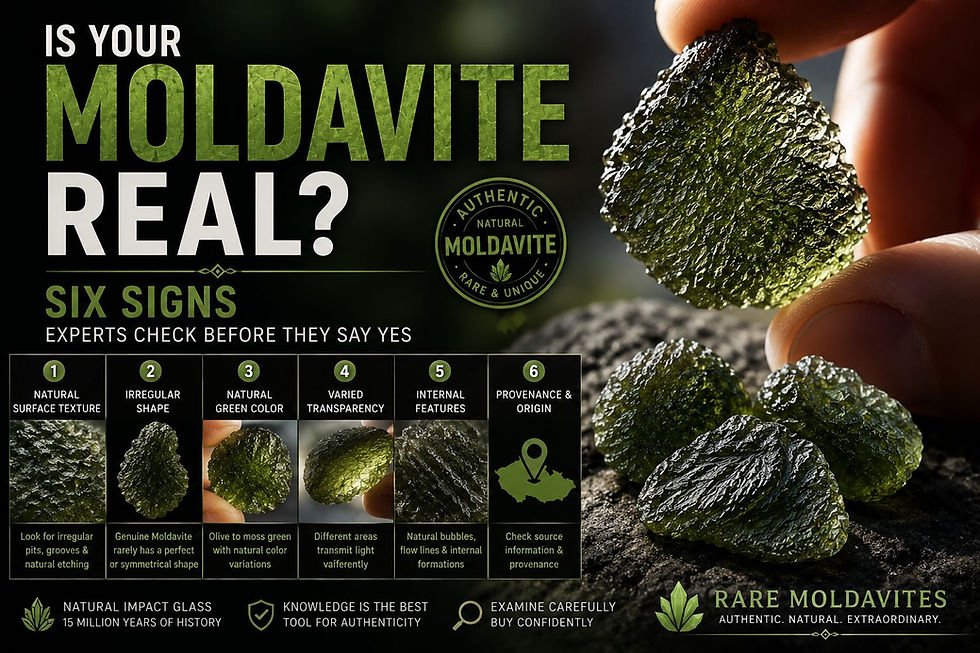
Surface Texture: The Most Immediate Clue
Real Moldavite has a naturally etched, rugged surface created by erosion in Czech soil over millions of years.
Genuine Moldavite shows:
Deep grooves and irregular ridges
Sculpted surfaces, not smooth finishes
Random natural patterns that never repeat
Fake Moldavite often looks glossy, rounded, or uniformly textured because it is shaped by molds or artificial abrasion.
Color and Transparency
Genuine Moldavite displays earth-toned green shades, ranging from:
Olive green
Forest green
Brownish green in some localities
When held to light, real Moldavite appears translucent but never crystal-clear. Artificial glass often looks too bright, neon, or overly transparent.
Internal Structure and Inclusions
Looking inside the stone provides another key indicator.
Authentic Moldavite contains:
Elongated bubbles
Flow lines from rapid cooling
Internal stress marks
Perfectly round bubbles or uniform internal clarity usually indicate man-made glass.
Weight and Density
Genuine Moldavite is lightweight compared to glass of similar size. Collectors often describe it as feeling “airy” rather than dense.
While weight alone is not proof, unusually heavy pieces for their size are suspicious.
Shape Consistency
Real Moldavite fragments formed during atmospheric flight and impact scattering. As a result, shapes are:
Asymmetrical
Aerodynamic
Naturally fractured
Perfect symmetry or decorative shaping is not consistent with natural Moldavite formation.
Documentation and Seller Transparency
Authenticity today relies heavily on documentation. Trusted sellers provide:
Origin verification
Locality information
Clear, unedited photos
Honest grading explanations
Refusal to provide origin details is a serious red flag.
Why Fakes Are Increasing
As Czech mining areas close and remaining fields become exhausted, supply continues to shrink. Meanwhile, global interest has grown rapidly.
This imbalance has created ideal conditions for counterfeit production, making education more important than ever.
Final Thoughts
Learning how to identify genuine Moldavite requires patience, observation, and respect for geological facts. Real Moldavite carries unmistakable signs of its cosmic origin etched texture, internal flow structures, natural coloration, and traceable Czech locality.
Authenticity protects both collectors and the legacy of this rare natural material.
Frequently Asked Questions
What is the fastest way to spot fake Moldavite?
A smooth, shiny surface is the most immediate warning sign. Genuine Moldavite always shows rough, naturally eroded textures created over millions of years in Czech soil. Uniform gloss or polished appearance strongly indicates artificial glass rather than natural tektite.
Should genuine Moldavite come with documents?
Yes. Trusted sellers provide origin verification and clear locality details. At Rare Moldavites, authenticity documentation confirms Czech impact-field origin. Sellers who avoid transparency or refuse to explain sourcing should always be approached with caution.
Is all green tektite considered Moldavite?
No. Moldavite is exclusive to Czech impact fields. Green tektites found elsewhere are unrelated materials. Rare Moldavites educates buyers on geological differences so collectors understand why only Czech Moldavite is authentic.
Why are fake Moldavite stones becoming more common?
Demand has increased while Czech deposits are nearly depleted. This scarcity raises value, attracting counterfeit production. Rare Moldavites focuses on education and sourcing transparency to help buyers avoid imitation stones.
Does size affect Moldavite authenticity?
Size does not determine authenticity, but it strongly affects rarity. Large genuine Moldavite pieces with verified origin are extremely rare and valuable. Rare Moldavites advises caution when large stones are offered at unrealistically low prices.
Can Moldavite be laboratory tested?
Yes. Advanced analysis can confirm tektite composition and impact-related structure. Rare Moldavites relies on geological standards, visual inspection, and verified sourcing rather than relying solely on chemical tests.
Are certain Czech regions more reliable than others?
All authentic Moldavite originates from Czech impact zones, but regions like Besednice are especially valued for sharp textures. Rare Moldavites provides locality transparency so collectors understand each stone’s background.
Does cleaning affect authenticity?
Improper cleaning can damage surface texture. Rare Moldavites recommends gentle methods such as brief water rinsing, moonlight exposure, or soft brushing to preserve natural features.
Is Moldavite an investment stone?
Because no new Moldavite will ever form, many collectors view it as a long-term collectible. Rare Moldavites emphasizes authenticity, condition, and origin as the foundation of lasting value.
Why is education important before buying Moldavite?
Understanding how to identify genuine Moldavite protects collectors from misinformation and imitation stones. Rare Moldavites prioritizes education so buyers make informed, confident decisions.

Comments