
Real vs Fake Moldavite: The Side-by-Side Comparison Nobody Actually Shows You

QUICK ANSWER BOX
The difference between real vs fake moldavite comes down to texture, internal structure, geological origin, and authenticity of sourcing. Genuine Moldavite formed approximately 14.8 million years ago after the Ries crater impact event and contains natural surface etching, flow lines, inclusions, and characteristics that manufactured glass struggles to replicate convincingly.
INTRODUCTION
Few collector stones create as much excitement and confusion as Moldavite. Over the past decade, demand for this rare green impact glass has expanded far beyond the traditional mineral collecting community and entered the worlds of luxury jewelry, crystal collecting, and social media trends. Unfortunately, this surge in popularity has also created one of the largest counterfeit markets in the entire mineral industry.
The subject of real vs fake moldavite has become increasingly important for collectors in the United States and across the world. Many buyers discover only after purchasing that the stone they believed was genuine was actually ordinary glass shaped and colored to imitate Moldavite. Some replicas are obvious, while others appear surprisingly convincing in photographs and videos.
Who This Is For: This guide is written for first-time buyers, advanced collectors, jewelry enthusiasts, and anyone interested in understanding how authentic Moldavite differs from imitation material. In this article, you will learn how to identify moldavite, understand the warning signs of fake specimens, and discover why geological details matter far more than marketing claims.
TABLE OF CONTENTS
• Why Fake Moldavite Exists Everywhere Today
• What Authentic Moldavite Actually Looks Like
• Surface Texture: The Detail Most Buyers Miss
• Internal Features That Reveal Authenticity
• The Most Common Fake Moldavite Types
• How Experts Authenticate Genuine Moldavite
• The Safest Way to Buy Authentic Moldavite
Why Fake Moldavite Exists Everywhere Today
The story behind counterfeit Moldavite begins with a simple economic reality. Authentic Moldavite formed during a single meteorite impact event approximately 14.8 million years ago. Unlike gemstones that can be continuously mined, Moldavite exists in limited quantities and primarily originates from deposits within the Czech Republic. Supply remains finite while demand continues growing every year.
As prices increased, counterfeit manufacturers entered the market aggressively. Social media accelerated the problem dramatically. Millions of people discovered Moldavite through videos and online discussions without learning anything about geological authenticity or Czech localities. This created ideal conditions for imitation products to spread quickly through online marketplaces.
Many fake pieces now appear convincing in photographs because sellers use professional lighting, editing software, and filters that hide obvious flaws. In many cases, buyers only realize the truth after comparing their purchase to a genuine specimen.
A common mistake I see among collectors is assuming expensive pieces must be authentic. High prices do not guarantee authenticity. Some counterfeit Moldavite sells for prices similar to genuine Czech material. Education remains the strongest protection available to collectors.

What Authentic Moldavite Actually Looks Like
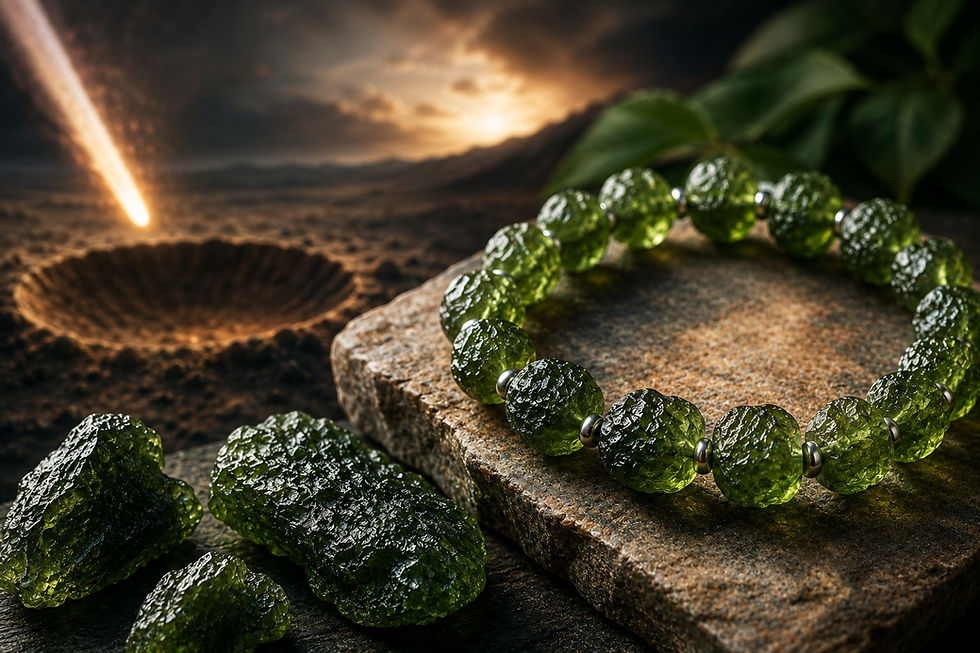
The term authentic moldavite refers specifically to natural impact glass formed during the Ries crater meteorite collision. Genuine Moldavite does not behave like ordinary green glass because the conditions that created it were extraordinary.
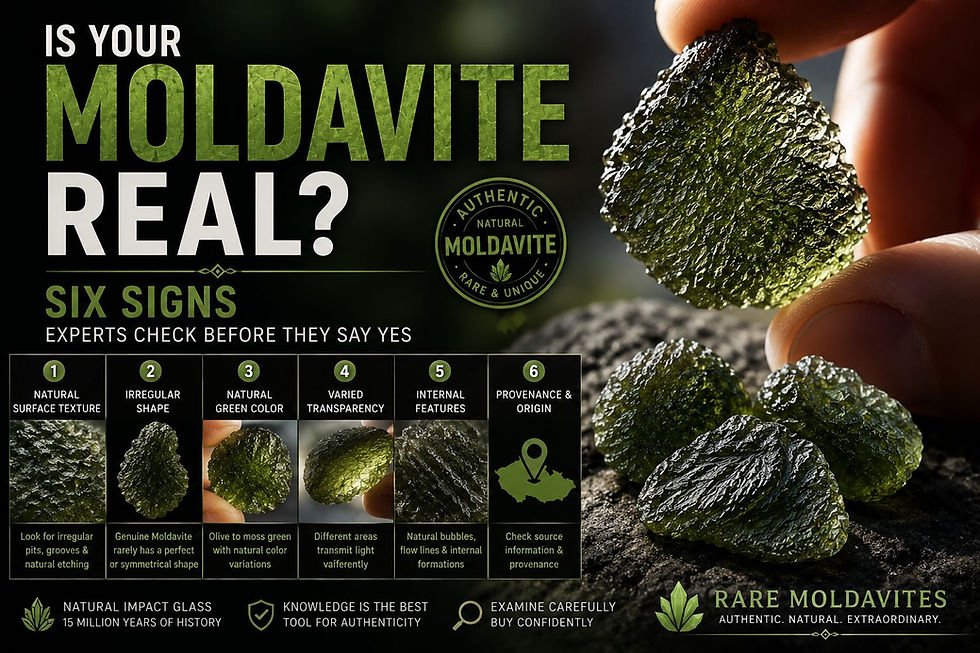
Authentic specimens often display irregular shapes, uneven contours, natural depressions, and organic-looking structures that feel almost sculptural. Color ranges from olive green to deep forest green, with subtle variations throughout individual pieces. Some areas may appear lighter and more translucent while others appear darker and richer.
Many buyers expect Moldavite to resemble polished gemstones found in jewelry stores. Genuine Moldavite rarely looks like that. Instead, authentic pieces often appear rugged, weathered, and naturally chaotic. Nature rarely creates perfect symmetry.
The imperfections collectors notice first often become the strongest indicators of authenticity. These irregularities represent millions of years of geological history rather than manufacturing precision. When working with collectors, I often find that the first physical comparison between genuine Moldavite and imitation glass changes their understanding immediately. The difference becomes obvious surprisingly quickly.
Surface Texture: The Detail Most Buyers Miss
One of the strongest indicators in the discussion surrounding real vs fake moldavite is surface texture. Genuine Moldavite contains natural etching created through atmospheric cooling and millions of years of environmental exposure underground. These textures rarely repeat themselves.
Grooves move unpredictably across the surface. Some areas contain sharp ridges while others contain softer contours. Deep sculpting creates shadows and highlights that shift depending on the angle of light. Manufactured glass struggles to reproduce this complexity.
Most fake Moldavite appears overly smooth or artificially glossy. Even chemically treated replicas often reveal repeated patterns or surface structures that look mechanical rather than geological. A useful analogy involves tree bark. Artificial tree bark may appear convincing from a distance, but close inspection immediately reveals the difference between natural growth and manufactured imitation.
The same principle applies to Moldavite. Highly respected localities such as Besednice demonstrate this perfectly through their famous hedgehog textures, which remain extremely difficult for counterfeit manufacturers to reproduce successfully. Collectors who study texture carefully often identify counterfeits faster than those focusing only on color.
Internal Features That Reveal Authenticity
The question of how to tell real moldavite usually leads collectors toward internal structure analysis. Genuine Moldavite formed under extreme conditions and preserved evidence of those conditions within the glass itself. Authentic specimens frequently contain flow lines, elongated gas bubbles, stress structures, and lechatelierite inclusions. These features formed naturally while molten material traveled through the atmosphere after the meteorite impact.
Counterfeit glass behaves differently. Manufactured glass often contains perfectly round bubbles distributed evenly throughout the material. Nature rarely produces this type of consistency. Many collectors mistakenly believe that bubbles automatically prove authenticity. This misunderstanding has resulted in countless expensive purchases of fake material.
The shape, distribution, and orientation of internal features matter significantly more than their simple presence. Modern microscopy and imaging technologies available in 2026 allow researchers and collectors to study these structures in extraordinary detail, making internal examination one of the most reliable authentication methods available today.
The Most Common Fake Moldavite Types
Counterfeit Moldavite enters the market in several different forms. Some manufacturers reshape bottle glass and apply acid treatments to create rough surfaces. Others use molds to produce identical replicas designed to imitate natural forms. Several warning signs appear repeatedly.
Extremely bright neon green coloration often indicates artificial production. Perfect symmetry should immediately raise suspicion. Identical pieces sold in large quantities almost always signal mass manufacturing. One collector recently shared photographs of multiple supposedly rare Moldavite pieces purchased online. Every specimen displayed identical grooves, identical dimensions, and identical internal structures.
Nature simply does not repeat itself with that level of precision. The counterfeit market follows a predictable cycle. Demand rises, supply remains limited, and imitation products attempt to fill the gap. Collectors who understand this pattern become significantly harder to deceive.
How Experts Authenticate Genuine Moldavite
Professional authentication rarely depends on one single test. Experts evaluate texture, internal structure, provenance, locality information, and geological consistency together. The process of how to identify moldavite becomes much easier when collectors stop searching for one magical answer and instead learn how multiple indicators work together.
Czech origin remains particularly important. Most collector-grade Moldavite comes from localities such as Besednice, Chlum, Slavce, South Bohemia, and Moravia. Trusted dealers openly discuss these origins because provenance represents an essential part of a specimen's value. A common mistake I see among collectors involves focusing entirely on appearance while ignoring sourcing information. Provenance matters.
For premium collector pieces, provenance often matters just as much as visual beauty. According to geological studies surrounding Central European tektites, authentic Moldavite shares structural and chemical characteristics directly linked to the Ries crater impact event approximately 14.8 million years ago.
The Safest Way to Buy Authentic Moldavite
The safest strategy for purchasing genuine Moldavite begins with choosing trusted specialists rather than general marketplaces. Reputable dealers provide locality information, detailed macro photography, and transparency regarding sourcing.
Collectors should ask questions confidently. Authentic dealers welcome discussions about Czech localities, internal structure, and geological history because education strengthens long-term trust. Suspicious sellers often avoid detailed conversations regarding provenance.
The cheapest Moldavite frequently becomes the most expensive mistake. For serious collectors, verified sourcing matters far more than finding the lowest price possible. Building knowledge transforms collecting from speculation into informed appreciation, and informed collectors rarely become victims of counterfeit products.
According to research published by the Geological Survey of the Czech Republic and studies examining Central European tektites, Moldavite formed during the Ries crater impact event approximately 14.8 million years ago. Researchers continue to identify consistent structural characteristics that distinguish authentic Moldavite from manufactured glass and modern imitations.
Frequently Asked Questions
What is the easiest way to identify a fake Moldavite?
The easiest way to identify fake Moldavite is by examining surface texture closely. Genuine Moldavite contains irregular grooves, natural etching, and organic sculpting created through geological processes rather than manufacturing methods. Counterfeit pieces often appear overly smooth, symmetrical, or artificially polished. Collectors who study authentic texture examples before purchasing dramatically improve their ability to identify imitation products quickly and confidently.
How can I tell if Moldavite is real without laboratory testing?
The best approach involves evaluating texture, internal structure, provenance, and locality information together. Authentic Moldavite frequently contains flow lines, elongated bubbles, and natural inclusions created during atmospheric cooling. Genuine Czech origin provides another strong indicator. Combining multiple observations provides a much more reliable result than relying on a single feature.
Can fake Moldavite contain bubbles too?
Yes, fake Moldavite can absolutely contain bubbles because ordinary glass manufacturing frequently creates them. The difference lies in the shape, distribution, and orientation of those bubbles. Authentic Moldavite usually contains elongated or irregular inclusions while manufactured glass often displays perfectly round and evenly distributed bubbles that appear artificial under magnification.
Why has fake Moldavite become so common recently?
Counterfeit Moldavite increased dramatically because demand expanded much faster than supply. Social media introduced Moldavite to millions of potential buyers while authentic Czech production remained limited. Counterfeit manufacturers recognized an opportunity and began producing increasingly sophisticated replicas. Education and trusted sourcing have therefore become essential for collectors in 2026.
Is authentic Moldavite worth paying more for?
Authentic Moldavite justifies its premium price because it represents a finite geological material created during a specific meteorite impact event millions of years ago. Genuine specimens contain natural structures and historical significance that cannot be recreated through industrial manufacturing. Serious collectors value rarity, provenance, and geological history as much as appearance.
CONCLUSION
Understanding the difference between real vs fake moldavite protects collectors from costly mistakes and disappointing purchases. Genuine Moldavite carries evidence of one of Earth's most extraordinary impact events, while imitation glass only copies the appearance of that history.
Texture, internal structure, provenance, and Czech origin remain the strongest indicators of authenticity. As counterfeit production continues increasing, educated collectors gain an enormous advantage. For collectors who value geological history, authenticity, and premium Czech sourcing, knowledge remains the most valuable tool in the entire Moldavite market.

Comments