
The Ries Crater Impact Event: The Day That Created Moldavite 14.8 Million Years Ago

QUICK ANSWER BOX
The ries crater meteorite impact occurred around 14.8 million years ago in present-day Germany when a massive asteroid struck Earth and ejected molten material across Central Europe. That superheated debris cooled rapidly in the atmosphere and formed Moldavite, a rare green tektite glass found mainly in the Czech Republic today.
INTRODUCTION
A single asteroid impact changed the geological history of Central Europe forever. Around 14.8 million years ago, a violent cosmic collision carved the Ries crater in southern Germany and scattered molten debris hundreds of kilometers away. That debris eventually cooled into Moldavite, one of the world’s rarest and most fascinating natural glasses. The ries crater meteorite impact is more than an ancient geological event. It explains the entire story behind moldavite origin, its unusual texture, deep olive-green color, and the reason collectors value authentic Czech specimens so highly today.
Who This Is For: This guide is designed for Moldavite collectors, crystal enthusiasts, geology lovers, jewelry buyers, and readers curious about how cosmic impacts can create rare natural materials on Earth. In this article, you will learn how Moldavite formed, why scientists classify it as tektite glass, what happened during the Ries impact event, and why this ancient collision still shapes the premium Moldavite market in 2026. The story begins with the asteroid itself.
TABLE OF CONTENTS
What Was the Ries Crater Impact Event?
How Moldavite Formed After the Impact
Why Moldavite Is Classified as Tektite Glass
What Makes Czech Moldavite Different
The Science Behind Moldavite’s Texture and Color
Why the Ries Impact Still Matters in 2026
How Collectors Identify Authentic Moldavite
What Was the Ries Crater Impact Event?
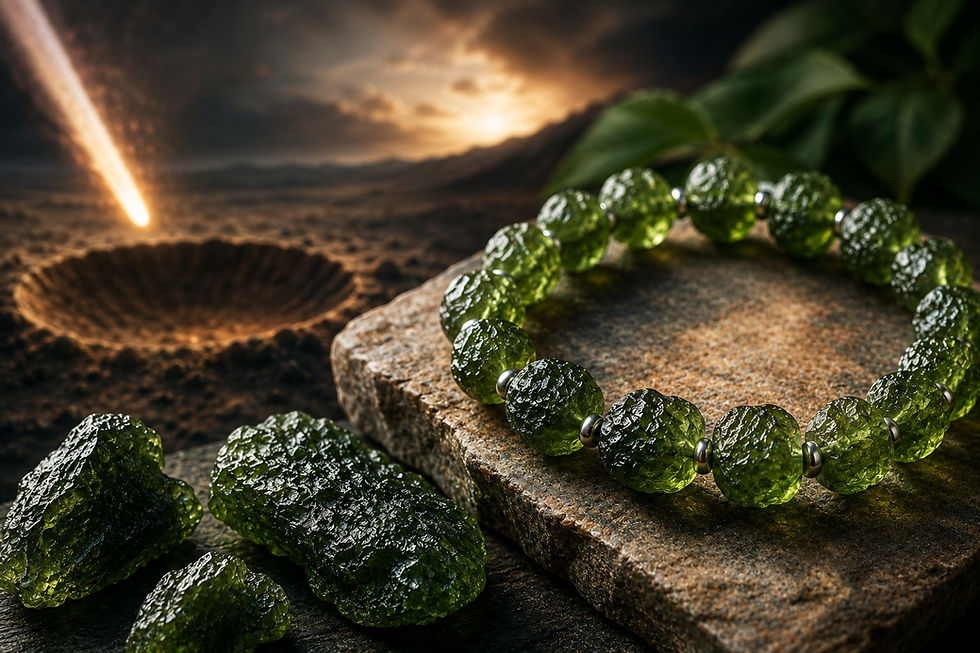
The Ries crater meteorite impact is defined as a massive asteroid collision that occurred approximately 14.8 million years ago during the Miocene epoch. Scientists believe the asteroid measured roughly 1 kilometer wide and struck Earth with enormous force near what is now Nördlingen, Germany. The collision released energy equivalent to millions of nuclear explosions. Temperatures rose instantly. Rock layers vaporized. Molten material blasted into the atmosphere at extreme speed. The impact created the Ries crater, which still exists today and measures about 24 kilometers across.
What makes this event extraordinary is the distance the ejecta traveled. The molten debris crossed hundreds of kilometers before landing mainly across southern Bohemia and Moravia in the Czech Republic. As the material cooled mid-flight, it solidified into natural green glass now known as Moldavite. Many online articles explain the crater itself but ignore the atmospheric process that shaped Moldavite’s etched texture. The cooling phase matters because it created the aerodynamic forms collectors recognize today.

Scientists from institutions including the University of Munich and the Natural History Museum in Vienna have studied the impact extensively. Their findings support the connection between the Ries crater and Czech Moldavite deposits. A common mistake I see among new collectors is assuming Moldavite formed inside the crater itself. Authentic Moldavite actually formed from ejected material traveling far beyond the impact zone. That distinction explains why genuine Moldavite localities are concentrated in the Czech Republic rather than Germany. The impact event also connects geology with cosmic history, which leads directly to the next question: how is moldavite formed after such an explosion?
How Moldavite Formed After the Impact
The phrase how is moldavite formed has a precise geological answer. Moldavite formed when terrestrial rock melted during the asteroid impact, launched into the atmosphere, and rapidly cooled before falling back to Earth.
This process separates Moldavite from volcanic glass like Obsidian. Moldavite is not volcanic. It is impact-generated glass created by hypervelocity collision conditions.
The formation process occurred in several stages:
The asteroid struck Earth at extreme velocity.
Surface rock melted and vaporized instantly.
Molten ejecta launched high into the atmosphere.
The material stretched and cooled during flight.
Glass fragments landed across Czech regions including Besednice and Chlum.
The rapid cooling phase explains Moldavite’s internal bubbles, flow structures, and lechatelierite inclusions. These microscopic details help gemologists verify authenticity today. A useful analogy is molten glass thrown through a freezing wind tunnel. The material twists, stretches, and hardens while moving. That dynamic cooling process created the sculpted shapes collectors admire.
Many competing articles mention the impact but skip the role of atmospheric aerodynamics. In reality, airflow shaped many Moldavite specimens during descent. Some pieces formed splash-like contours while others developed deep natural grooves. Modern scanning techniques used in 2026 reveal increasingly detailed internal structures inside genuine Moldavite. These findings strengthen scientific understanding of the moldavite origin story and help distinguish authentic specimens from modern fakes. The formation process also explains why Moldavite belongs to a larger family of rare impact glasses known as tektites.
Why Moldavite Is Classified as Tektite Glass
The term tektite glass is defined as natural glass formed from meteorite impacts rather than volcanic activity. Moldavite belongs to this category because it formed directly from the Ries crater collision.
Scientists classify Moldavite as a tektite due to several characteristics:
Extremely low water content
Rapid cooling structure
Aerodynamic shapes
High silica composition
Evidence of impact-generated melting
Unlike common glass, Moldavite contains microscopic features linked to violent pressure and heat. Genuine specimens often display flow lines and trapped gas bubbles visible under magnification.
Comparison between Moldavite and volcanic glass reveals major differences:
Moldavite formed from impact ejecta.
Obsidian formed from volcanic lava.
Moldavite traveled through the atmosphere.
Obsidian cooled near volcanic surfaces.
Moldavite contains impact-related inclusions.
Obsidian usually lacks aerodynamic sculpting.
This classification matters because many fake Moldavite products sold online imitate ordinary green glass rather than authentic tektite material. According to geological research published by the Geological Survey of Austria, Moldavite’s chemical composition strongly supports its connection to terrestrial sedimentary rocks affected by the Ries impact event.
In my experience working with collectors and reviewing specimens, authentic Moldavite almost always shows natural irregularity. Perfect symmetry usually signals modern manufacturing rather than natural impact formation. The tektite classification also explains why Moldavite holds such a special place among meteorite enthusiasts, mineral collectors, and spiritual crystal communities worldwide. Its rarity becomes even clearer when examining the limited Czech localities where authentic Moldavite is found.
What Makes Czech Moldavite Different
The moldavite origin story is inseparable from the Czech Republic. Genuine Moldavite comes mainly from South Bohemia and Moravia, where impact ejecta settled millions of years ago.
Famous localities include:
Besednice
Chlum
Slavce
Nesmen
Radomilice
Each locality produces Moldavite with slightly different characteristics. Besednice specimens often show dramatic thorn-like textures. Chlum Moldavites may appear smoother with elegant elongated forms. Collectors value locality-specific Moldavite because supply continues shrinking every year. Many historic mining areas have already been depleted or heavily restricted. This scarcity has increased global demand in 2026, especially among high-end collectors searching for verified Czech specimens. Luxury mineral auctions now feature Moldavite alongside meteorites, Libyan Desert Glass, and Muonionalusta fragments. A real-world example highlights this trend clearly. A collector-grade Besednice Moldavite with strong hedgehog texture recently sold for several times the price of a standard smooth specimen of equal weight. Texture, provenance, and locality now influence value as much as size.
Many competitor articles discuss Moldavite spiritually but fail to explain why locality matters geologically. Locality determines texture variation, preservation quality, and collector rarity. Authentic Czech Moldavite also differs visually from fake products because natural pieces show uneven surfaces created during atmospheric cooling and long-term erosion. Artificial replicas often look glossy, uniform, and unnaturally smooth. Understanding locality helps collectors avoid mistakes while appreciating the geological journey behind each specimen. The next step is learning how science explains Moldavite’s unusual physical appearance.
The Science Behind Moldavite’s Texture and Color
The appearance of Moldavite reflects both violent formation and millions of years of environmental exposure. Genuine Moldavite usually ranges from olive green to deep forest green because of its iron content and internal chemical structure.
The surface texture developed through two main stages:
Atmospheric shaping during flight
Long-term erosion in soil deposits
The aerodynamic phase created stretched contours and flow structures. Later, acidic soils etched the surface over millions of years and produced the intricate sculpture seen on collector-grade pieces today.
Microscopic analysis reveals several authenticity markers:
Flow lines
Gas bubbles
Natural pitting
Lechatelierite inclusions
Irregular internal structures
These features are extremely difficult to duplicate convincingly.
Many fake Moldavite sellers use acid-treated bottle glass or machine-carved replicas. These imitations often appear overly shiny or display repetitive patterns. Genuine Moldavite feels more organic and unpredictable. The science behind Moldavite also explains why no two specimens look identical. Every fragment traveled differently through the atmosphere before landing. Each piece cooled under unique conditions.
NASA impact studies and European geological research continue improving scientific understanding of impact-generated materials. Advanced imaging used in 2026 now allows researchers to analyze internal stress patterns within Moldavite without damaging specimens. For collectors, these scientific details provide confidence. For geology enthusiasts, they reveal the extraordinary complexity hidden inside a small piece of green glass. That scientific value connects directly to why the Ries crater story remains important today.
Why the Ries Impact Still Matters in 2026
The ries crater meteorite impact still matters because it connects planetary science, geology, collecting culture, and public fascination with cosmic events. Modern researchers study impact craters to understand Earth’s geological history and potential asteroid risks. The Ries crater serves as one of Europe’s best-preserved impact structures and remains an important research site.
At the same time, Moldavite demand continues growing globally. Interest increased sharply through social media, collector communities, luxury jewelry markets, and spiritual wellness trends. Yet supply remains limited because Moldavite exists only in a small geographic region.
This imbalance creates several challenges:
Rising counterfeit production
Overharvesting concerns
Increased prices for premium specimens
Greater need for authentication
Trusted sources now matter more than ever. Buyers increasingly seek verified provenance, locality documentation, and expert evaluation before purchasing high-value Moldavite.
Brands like Rare Moldavites focus heavily on authenticity because modern collectors want geological confidence, not just visual appeal. The Ries impact story also gives Moldavite emotional depth. People connect with the idea that a violent cosmic event created something unexpectedly beautiful. Few minerals carry such a dramatic origin story tied directly to a known asteroid impact. As scientific imaging improves and collector awareness expands, the historical importance of Moldavite will likely grow even further. That makes authentication knowledge essential for both new and experienced buyers.
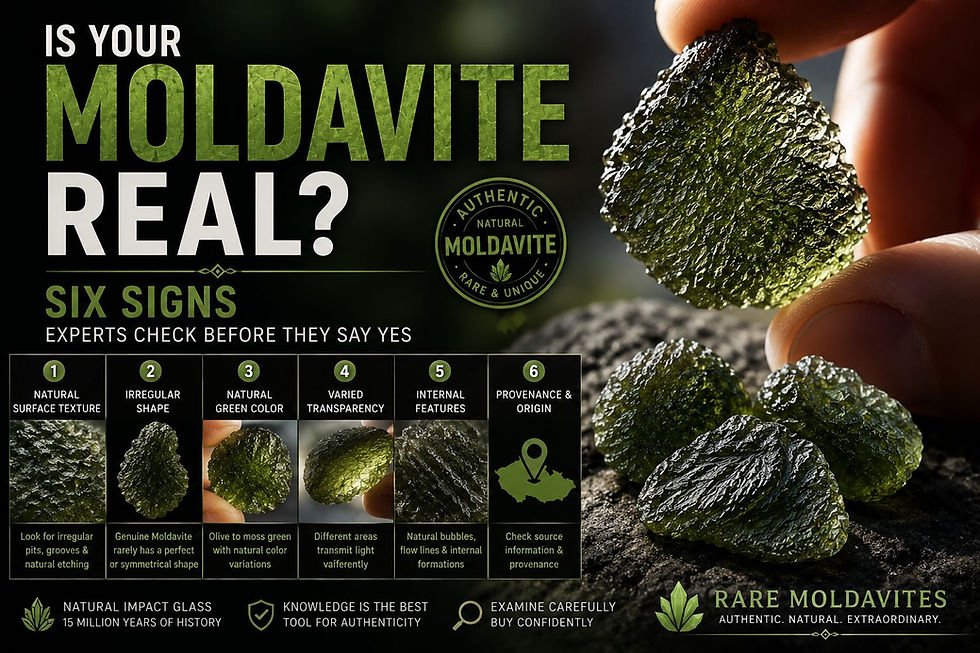
How Collectors Identify Authentic Moldavite
Authentic Moldavite identification combines geology, observation, and experience. Genuine specimens display features impossible to reproduce perfectly in mass-produced glass replicas.
Collectors usually evaluate Moldavite using several checkpoints:
Surface Texture
Natural Moldavite surfaces appear deeply etched and irregular. Collector-grade pieces often show intricate sculpting created through erosion and atmospheric shaping.
Internal Features
Under magnification, authentic Moldavite reveals bubbles, flow lines, and natural inclusions. Fake glass often looks too clean internally.
Color Variation
Real Moldavite rarely shows perfectly uniform green coloration. Subtle shifts between olive, moss, and forest green are common.
Provenance
Trusted sellers provide origin details and locality information. Verified Czech sourcing matters greatly in the premium market.
Weight and Feel
Genuine Moldavite feels lighter than many buyers expect because of its glass structure.
A common mistake I see involves relying only on color. Many fake pieces achieve a convincing green shade. Texture and internal structure provide much stronger evidence. Experienced collectors often compare Moldavite authentication to evaluating natural emeralds or meteorites. Tiny imperfections become proof of authenticity rather than flaws. For buyers entering the market in 2026, education remains the best protection against counterfeits. Understanding the Ries crater event helps collectors appreciate why authentic Moldavite carries both scientific and historical significance.
According to the Earth Impact Database and geological studies conducted by researchers associated with the University of Munich, the Ries crater formed approximately 14.8 million years ago after a high-velocity asteroid impact in southern Germany. Researchers concluded that Moldavite originated from terrestrial material ejected during the collision and rapidly cooled while traveling through the atmosphere. This connection remains one of the strongest documented links between a specific meteorite impact crater and a known tektite field.
Frequently Asked Questions
What is the Ries crater meteorite impact?
The ries crater meteorite impact was a massive asteroid collision that occurred about 14.8 million years ago in present-day Germany. The impact created the Ries crater and launched molten debris across Central Europe. That debris eventually cooled into Moldavite, which scientists classify as natural tektite glass. The event remains one of the most important impact formations linked directly to a known tektite field.
How is Moldavite formed naturally?
Moldavite formed when the Ries asteroid impact melted terrestrial rock and ejected it high into the atmosphere. The molten material cooled rapidly during flight before falling into areas of the Czech Republic. This rapid cooling process created the bubbles, flow lines, and etched textures found in authentic Moldavite today. Moldavite did not form through volcanic activity, which separates it from volcanic glass like Obsidian.
Why is Moldavite only found in the Czech Republic?
Moldavite is found mainly in the Czech Republic because the impact ejecta from the Ries crater traveled and landed in regions such as South Bohemia and Moravia. Geological conditions in these areas preserved the material over millions of years. Scientists believe the distribution pattern reflects the direction and force of the original explosion. Smaller tektite fragments exist elsewhere, but collector-grade Moldavite comes primarily from Czech localities.
What makes Moldavite different from regular green glass?
Moldavite differs from ordinary green glass because Moldavite formed through a meteorite impact rather than industrial manufacturing. Genuine Moldavite contains natural bubbles, flow structures, and lechatelierite inclusions created by extreme heat and pressure. Fake glass usually appears smoother, more uniform, and artificially glossy. Authentic Moldavite also displays irregular etched textures developed over millions of years underground.
Is authentic Moldavite rare in 2026?
Authentic Moldavite is increasingly rare in 2026 because mining areas continue shrinking while global demand grows. Many historic Czech localities produce far fewer specimens than in previous decades. High collector interest and counterfeit production have also increased pressure on the market. Verified Moldavite with strong provenance and locality documentation now commands significantly higher prices than common commercial-grade pieces.
What is the best way to tell if Moldavite is real?
The best way to identify real Moldavite is by examining texture, internal structure, provenance, and locality information together. Genuine Moldavite usually contains natural bubbles, flow lines, and uneven surface sculpting. Professional magnification often reveals details fake glass cannot replicate convincingly. Buying from trusted specialists with documented Czech sourcing provides the strongest protection against counterfeits.
Is Moldavite worth collecting for geology enthusiasts?
Moldavite is highly valued among geology enthusiasts because it represents a direct connection between Earth and a documented asteroid impact event. Few natural materials combine impact science, atmospheric physics, mineralogy, and collectible rarity so clearly. Many collectors appreciate Moldavite not only for appearance but also for its geological story. The connection to the Ries crater gives Moldavite exceptional scientific and historical importance.
CONCLUSION
The story of Moldavite begins with one of Europe’s most powerful asteroid collisions. The ries crater meteorite impact did more than create a crater in Germany. It launched molten material across Central Europe and formed one of the world’s rarest natural glasses.
Understanding moldavite origin helps collectors appreciate why authentic Czech Moldavite carries such scientific, historical, and emotional value. From atmospheric cooling to etched textures and locality differences, every genuine specimen preserves evidence of a cosmic event that happened 14.8 million years ago.

Comments